Blog Categories
GSoC 2026: KRMU B.Tech. Student Wins ₹3L Google Stipend
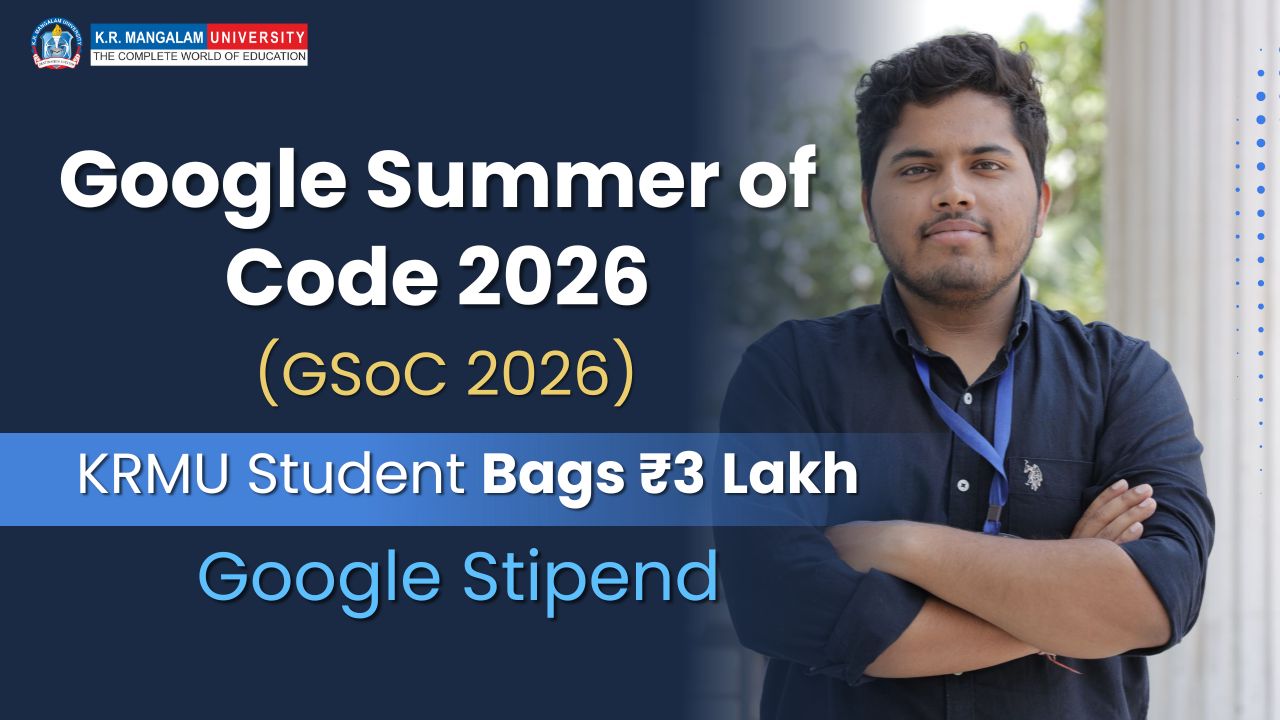
Most engineering students spend four years preparing for placements. Some spend those same years building projects for the global open-source community instead. This year, that difference translated into a ₹3,00,000 stipend paid directly by Google for the prestigious Google Summer of Code (GSoC 2026) to a third-year B.Tech CSE student from Gurugram.
Jayant Parashar, currently in his 6th semester of B.Tech CSE at K.R. Mangalam University (KRMU), was selected as a contributor to GSoC 2026. GSoC is one of the world’s most competitive open-source programmes, where contributors are selected not through exams or campus recruitment drives, but through publicly visible coding contributions, technical proposals, and peer evaluation by experienced engineers.
This blog is not simply about one student’s achievement. It is about what made it possible. A structured system that KRMU’s School of Engineering and Technology (SOET) has built for exactly this purpose, called the Open Source Mentorship Programme. But before we get into how this mentorship programme works, let’s first shed some light on what GSoC actually is and why getting selected is as difficult as it sounds.
What is Google Summer of Code?
Google Summer of Code is a programme that funds developers to contribute to real open source software projects. It is a stipend-based programme that Google runs for more than 12 weeks. GSoC 2026 is the 22nd season of this programme that has produced over 22,000 contributions from across 123 countries since its inception in 2005.
This year, 184 of the leading open source organisations participated in GSoC 2026. These participants publish a list of project ideas for which the contributors have to study the codebase, submit pull requests and then write a detailed technical proposal for the project they want to tackle. Mentors from the participating organisations review every proposal and interview shortlisted candidates before making their selections. Only the strongest proposals pass through the process.
As a result, selected candidates earn a credential that carries genuine industry weight. A GSoC selection tells any hiring manager that this person can identify a real problem, design a technical solution, communicate it clearly to experts, and execute it independently.
How Jayant Got Selected in GSoC 2026
Jayant Parashar, a 6th-semester B.Tech CSE student at KRMU’s School of Engineering and Technology, was selected by FOSSASIA, one of the world’s most active open-technology organisations. He was one of the contributors selected from 15,245 applicants from 131 countries in GSoC 2026.
Jayant has a simple goal – making the lives of PyTorch developers easy. His GSoC 2026 project tackles something that quietly frustrates a lot of people working in deep learning, called manual logging. Every time you run an experiment, you’re tracking loss, accuracy, learning rates, etc., and it’s all done manually. This mundane approach slows you down, and it can be automated.
So he’s building native autologging directly into Visdom, a tool that many PyTorch developers already utilise for visualisation. Once it’s in place, the tracking happens automatically, in real time, without the researcher having to think about it. It is a clean, simple, and genuine time-saver.

Not only that, this project goes far beyond that. It also includes support for PyTorch Lightning, multi-GPU configuration, and smart experiment versioning. And he’s writing proper documentation throughout, so it’s actually usable in production from day one.
None of this happened overnight. Before he even submitted a proposal, Jayant spent a lot of time scrolling through FOSSASIA’s codebase. He made real contributions, got involved with the community, and built the kind of credibility you can’t fake.
Reflecting on his experience, Jayant shares: “My journey into open source started with contributions to projects like PyTorch, ExecuTorch and Mesa, where I learned how to work with large codebases and collaborate with global developer communities. Through GSoC 2026, I’m contributing to the PyTorch ecosystem by building native autologging integration for Visdom, making experiment tracking and real-time visualisation simpler and more accessible for deep learning researchers.”
The stipend of ₹3,00,000 is paid by Google in two instalments, including 45% upon passing the midterm evaluation and 55% upon successful completion of the final evaluation. Both evaluations are conducted by his assigned FOSSASIA mentor, based on the quality and progress of his code contributions.
SOET’s Open Source Mentorship Programme
When results like Jayant’s occur, there is a temptation to attribute them to individual brilliance. While it is easy to view this as an individual achievement, the bigger story lies in the system that helped make it possible.
KRMU’s School of Engineering and Technology (SOET) runs a dedicated Open Source Mentorship Programme, driven by the SOET Technical Training Team. It is a structured, six-month preparation cycle designed to bridge the gap between classroom learning and real-world software development through open-source contributions on real projects.
The programme is not limited to GSoC. It prepares students for LFX Mentorship, Summer of Bitcoin, Hacktoberfest, MLH Fellowship, and Outreachy. It builds a portfolio of globally recognised, stipend-based open-source opportunities that most engineering colleges in India do not address at all.
This matters because open-source contribution has become one of the most credible signals an engineering student can send to a prospective employer. A public GitHub profile with merged pull requests in a major project tells a hiring manager something that a marksheet simply cannot. SOET has built the infrastructure to help students build exactly that kind of record.
The Open Source Mentorship Programme, however, is only one part of what KRMU’s SOET has built. The university provides robust facilities and a curriculum aligned with industry demands, fostering a learning environment that sparks a spirit of curiosity and creativity among the students. In addition, KRMU also bridges the gap between academics and industry by providing hands-on exposure through hackathons, live projects, research initiatives, and corporate internships. Students engage in real-world problem-solving, collaborate with industry leaders, participate in technical bootcamps, and gain entrepreneurial insights through startup incubation programmes.
What Does a Google Summer of Code Stipend of ₹3 Lakh Actually Mean?
The ₹3,00,000 that Jayant received from GSoC 2026 is not a scholarship awarded at the end of a degree. It is not a prize from a college competition. It is a professional stipend, earned during the third year of his undergraduate programme, paid by Google to compensate him for delivering a real software project to a real engineering standard. The implications of that are significant, such as the following:
First, the money arrives while the degree is still in progress, providing a meaningful financial return a year before graduation.
Second, the evaluation was conducted by practising engineers at a global open-source organisation, not by faculty. That distinction matters enormously when a student appears for job interviews later.
Third, there is no Non-Disclosure Agreement (NDA), no employment obligation, and no exclusivity clause. The experience, the code, the certification, and the professional network all belong entirely to the student.
For context, many postgraduate stipends in India, including some government research fellowships, pay less per month than what Jayant will receive across this summer. He is still in his third year of a four-year degree.
Conclusion
Jayant Parashar’s GSoC 2026 selection is significant, but the greater significance lies in what it demonstrates about the environment that produced it. KRMU’s School of Engineering and Technology offers multiple industry-aligned B.Tech CSE programmes. The highest placement package to date has been of ₹56.6 LPA and every year, over 800 companies visit the university for campus placements.
The Open Source Mentorship Programme is active and open to students entering SOET in the 2026-27 academic session. The six-month preparation cycle, the technical training team, and the structured pathway to events like GSoC are in place and waiting for the next cohort.
If engineering college options in Delhi NCR are on your list right now, this is the kind of outcome that deserves a closer look. Explore KRMU’s SOET and choose the trajectory for a bright and impactful career for life.
Google Open Source Summer of Code is a global programme run by Google that aims to bring engineering students and open source organisations together to solve real-world software problems. In India, the Google Summer of Code stipend is not a fixed amount, but it depends on the project size and the Purchasing Power Parity (PPP). However, a typical standard project can get $3,000 US. No, GSoC is an open programme for all engineering students, where the contributors are selected purely based on their open source contributions and proposals for desired solutions. On the other hand, Security Operations Centre or SOC internships are offered by companies based on the candidates’ resumes, followed by an interview. Absolutely, students can apply for GSoC as soon as they start their first semester of engineering. Yes, KRMU runs a dedicated Open Source Mentorship Programme under the School of Engineering and Technology, driven by the Technical Training Team. It is a systematic 6-month preparation cycle that helps students to gain exposure to real-world open source projects. FAQs
What is Google Open Source Summer of Code?
How much is the Google Summer of Code stipend in India?
Is GSoC the same as a regular SOC internship?
Can a first or second-year engineering student apply for GSoC?
Does KRMU have a programme that helps students prepare for GSoC?
Recent Post
Best Courses After 12th in India 2027: Science, Commerce & Arts
Mental Health Awareness: Importance, Signs & Support in India
GATE Registration 2027: Eligibility, Dates & Complete Process!
Best Interior Design Universities in Delhi NCR: Choose the Right One!
B.Tech. AI ML Universities in Delhi NCR: Choose the Right One
B.Tech. Data Science vs B.Tech. Cyber Security: What’s Best in 2026?
B.A. English Honors Course Admission, Eligibility & Career Scope
BCA Course After 12th: Best College, Fees, Curriculum and More
Top Engineering Colleges in Gurgaon: Admission, Fees & Placement Guide
Best University in Delhi NCR, Haryana: Admissions & Fees Guide
CUET PG Study Plan 2026: Exam Pattern, Duration & Key Tips!
How to Become a Journalist: Skills, Courses, Salary & Career Path
Know the Difference Between B.A. LL.B. and B.A. LL.B. Hons.!
Entrepreneurship Development Programme: Meaning, Objectives & Need
CTET Exam Date 2026: Eligibility, Syllabus, Pattern & Admit Card
Career Options After BSc Physics Honours: Top Jobs & Salary Guide
Scope of Political Science: Importance, Career Options & Courses
All India Forensic Science Entrance Test (AIFSET-2026) Details and Eligibility
Explore the Top Artificial Intelligence University in India
BBA HR Management Syllabus: Semester-Wise Detailed Curriculum
Best AI Colleges in India: Fees, Admissions & Placement Insights
Top B.Tech. Universities in Delhi: Rankings, Fees & Admission
Explore the Best Courses After Graduation for High Salary
BSc Data Science: Syllabus, Careers, and Data Science Course
Understanding the Difference Between Logistics and Supply Chain Management
Is Data Science a Good Career Choice? Salary, Scope & Future Growth Explained
Integrated Course After 12th: Complete Guide, List and Benefits
Moot Court for Law Students: Its Importance and Objectives
CAT 2025: Exam Date, Eligibility, Syllabus, Registration & Preparation Tips
Career Guidance and Counselling: Expert Support for a Successful Future
Importance of Internships: Boost Your Career with Real-World Experience
What to Do After CUET Result: Courses, Counselling & Admission Process
CUET Result 2025 Out: Check Scores, Cut-Offs & What to Do Next
Explore the Best College for MBA in Marketing in Delhi NCR
Pursue Bachelor’s Degree in Journalism & Mass Communication at KRMU
BCA Course After 12th: Eligibility, Fees, Career Scope & Admission Guide
BBA in Digital Marketing: Eligibility, Subjects, Fee and Scope
Ph.D. in Mechanical Engineering: Eligibility, Admission and Fee Details
D Pharmacy Admission: Eligibility, Fees, Syllabus & Career Scope
Is B.Sc. Computer Science Worth It? Salary, Scope & Future Prospects
GMAT Exam 2025: Eligibility, Syllabus, Exam Pattern and More
KRMU: The Destination to Become a Future-Ready Software Engineer
Ph.D. Pharmaceutical Sciences: Course Details and Admission Process
Why KRMU is the Best College for BCom Hons. in Gurugram, Delhi NCR
JEE Mains 2025 Exam Date: Syllabus, Last date, Registration Date
Career After MA English: High Paying Jobs and Government Roles
Why K.R. Mangalam University Is The Best Fine Arts University in India?
Navigating The Law Careers: Options, Opportunities, and Insights
Benefits of a Culinary Arts Bachelor Degree for Aspiring Chefs
Architecture Careers In India: Your Path To A Successful Future
Is NTA CUET UG Score Mandatory For Admission In All Universities
Data Science and Artificial Intelligence: Revolutionising the Digital Age
Exploring Top Career Options For Commerce Students After The 12th
Exploring The Best Course After B Com To Elevate Future Prospects
The Difference between BE and BTech: Everything you need to know
Exploring Jobs After BSc Chemistry: Private And Government Jobs
Best Professional Courses After 12th for a High-Paying Career
Why KRMU Is Considered One Of The Best BSc Agriculture Colleges In India?
A Complete Guide On Full Stack Development: Career Paths/Eligibility/Duration
Why KRMU Is Considered One Of The Best Hotel Management Colleges In India
Hotel Management Course Fees in Private College: What You Need to Know
Everything You Need to Know About Integrating Dual Degree Programs
Textile Design Course, Eligibility and Career Opportunities
Physiotherapy Course Fees: Career Paths/Eligibility Criteria/Top Colleges
Exploring BJMC Colleges in Delhi: Your Comprehensive Guide
Difference Between B.Sc. And B.Sc. Hons.: Which One Is Better?
A Comprehensive Guide B Pharm Duration, Syllabus, Job Opportunities
Pharmacokinetics in action: the science behind drug dynamics
BCA Full Form And Subjects- Comprehensive Understanding Of BCA
Complete Guide of B Sc Agriculture Course Duration, Admission Process, Fees
A Detailed Guide On How To Become A Fashion Designer After 12th
Navigating Sustainability Trends: Preparing Students for Corporate Priorities in 2024
List Of Top Career Options After B.Tech Computer Science & Engineering
How to Choose the Right 12th Commerce Courses for Your Salary?
Local tourism: Key to unlocking India’s huge tourism ecosystem
K.R. Mangalam University: A Leading University For Comprehensive Excellence
Understanding BBA Travel & Tourism: A Gateway To A Thriving Future
Why Choose B Tech Cyber Security: Learn Eligibility/Benefits/Career/College
Benefits of Pursuing An MBA After BA: Career/Specialisations/Entrance Exam
Exploring the UX/UI Race in B.Tech. Computer Science & Engineering
BBA in Human Resources: A Strategic Move for Future HR Leaders
Exploring the UX/UI Race in B.Tech. Computer Science & Engineering
B.Tech Computer Science Course: Eligibility, Syllabus, Exams, Fees, Scope
Exploring a BBA in Finance: Your Comprehensive Guide to a Promising Career Path
Compelling Reasons to Choose a BBA Program in Travel and Tourism
BA Political Science Honours: Your Path to Political Insight
Beyond Fashion Designing: Exploring the Creative World of B.A. Arts
Unlocking the Path to Success: Your Thriving Career in Cyber Security
B.Sc. Forensic Science Course: Eligibility, Scope & Top Jobs
The Art of Public Speaking: Tips for Confident Presentations
Advancing Your Career: Pursuing Diploma Courses After 10th Grade
Computer Science Engineering: Unraveling the Realm of Technology and Innovation
The Ultimate Guide to Choosing the Right Data Science Course for Your Career
Internship and Practical Training Opportunities for B.Com (Honours) Students
Exploring Career Scope of Pharmacology: A Promising Pathway
The Rise of Fintech: Revolutionizing India’s Financial Landscape
The Advancement Postgraduate Courses in India Career Development
Understanding the Difference Between Psychologist and Psychiatrist
Career in Fashion Designing: Full Guide from Start to Destination
Exploring a Career in Criminal Law: An In-Depth Guide to LLB Criminal Law
Unveiling the Role of a Supply Chain Analyst: A Path to Success
Comparing CSE and IT: Unveiling Distinctions and Career Opportunities
Exploring the Educational Landscape: Top Universities in Gurgaon
Traditional Marketing vs Digital Marketing: Exploring their Pros and Cons
The Basics of B Tech: What You Need to Know to Pursue a Degree in Technology
How To Become An Interior Designer in India: Qualification & Career Scopes
Exploring the Benefits of an International Accounting and Finance Course
BA LLB (Hons): A Comprehensive Guide to Understanding the Program
5 Full Stack Web Development Course Lessons from the Professionals
Training the future educators at the Best B.Ed College in Gurgaon
Gain Exceptional Business Expertise with Best B-School in Gurgaon
Best Undergraduate Courses to Study in India for a Promising Career
Unleashing Creativity and Empowering Dreams: Why Pursue Architecture program after 12th
CTET 2023: Registration details for Central Teacher Eligibility Test
Develop Forensics Expertise with Best BSc Forensic Science Course in Delhi
Best BSc Hons Mathematics Scope: Career Options and Responsibilities
Best Courses After 12th Commerce – Professional Programmes & More
A Detailed Overview of Best Journalism Courses After 12th
Integrated BBA MBA Course Details, Eligibility and Career options
BBA LLB Hons: Admission, Eligibility, Subjects, Scope and Jobs
What should You Do after completing BA in Political Science (honors)
Why studying Machine learning is a good career option after 12th
Ultimate Guide to CAT Exam: Admit card, Exam Date, Syllabus and Preparations
BA Honours in English: Course Details, Syllabus, Eligibility and Career Options
Career and Scopes after BCA with Artificial Intelligence and Data Science
Which Course Should I Choose After Completing 12th from Arts Stream?
Why choose MCA: Course details, Eligibility, Benefits, Career Options and Salary
Career, Scopes and Salary after B.Tech CSE with Specialisation in Cloud Computing
Career and Opportunities after completing your B.Tech Civil Engineering
What are the advantages of pursuing a B.Tech. in (CSE) with specialization in UX/UI
Can a PCB Student do B.Tech in Computer Science Engineering
Why pursuing a BA (Hons.) – Chinese Degree can be a good choice for you?
Top Soft Skills That You Need to Develop for a Successful Career
Why Choose B.Tech. Mechanical Engineering after Class 12?
How to Choose the Best Career Path: Machine Learning Engineer or Data Scientist
Top 20 Things Architects Can Do After B.Arch in India: A Must Read!
Get Better Job Opportunities with the Help of Top Colleges for MCA in Delhi NCR
K.R. Mangalam University Gears up to Sign MoU with Sputnik News Agency, Moscow
How Is Artificial Intelligence Shaping The Pharmacy Industry Of Today
The Emergence Of E-Commerce And E-Business In The Post-Pandemic World
The Role And Contribution Of Chemists In Improving The Overall Healthcare Scenario
5 Best Paying Jobs For Journalism & Mass Communicationgraduates
Clinical Psychology – Career Scope & Earning Potential In India
Challenges & Opportunities For Fashion Designers In The Post Covid World
The Invincible Role Of Medical & Allied Sciences Professionals Amid The Covid Crisis
The Emerging Role Of Information Technology In The Field Of Journalism
Indian Pharma Growing As The Largest Sector In Terms Of Employment & Revenue
Covid-19 Projects At KRMU: An Effort To Raise Awareness Among The Young Gen
Cybersecurity: A Much Sought-After Profession In Today’s Technology Oriented World
The Worth Of Industry-Vetted Management Training In 21st-Century Corporate World
Understanding The Twenty-First-Century Entrepreneurial Challenges
Why The World Of Fashion Needs Trendsetters Rather Than Followers?
Technological Trends Changing The Face Of Architecture Today
5 Significant Ways In Which The Industry Of Journalism Has Evolved Over The Years
Acquiring The Right Workforce Is The Key Requirement For Meeting Business Goals
The Vitality Of Application & Research-Based Learning For The 21st-Century Youth
Need for Legal, Administrative & Judicial Reforms in India
How Will The Current Pandemic Change The Fashion Industry Worldwide?
Business Journalism – An Emerging Career Path For The 21st Century Youth
The Growing Use Of Business Analytics In Financial Services Industry
5 Tips For Beginners To Survive & Thrive In The Fashion Industry
Five Skills You Inevitably Need To Succeed As An Interior Designer
How Is The Advancing Technology Redesigning The Fashion Design Industry?
Top Technical Skills That Are Highly Demanded in The Modern Job Market
Soil Science – Career Potential & Opportunities In India And Abroad
Key Skills You Need To Thrive In The Domain Of Hotel Management
The Role Of KRMU ICC In Establishing A Safe & Secure Environment In The Campus
What It Takes To Grab The Best Jobs In The Fashion Design World?
K.R. Mangalam – Building A Generation Of Creative Fashion Designers
International Exposure Is Crucial For Ensuring Professional Success In The Global Market
What Makes Project-Based Learning Imperative For The Youth Of Today
KRMU’s Engineering Kitchen Inspiring The Youth To Shape A New World Of Innovation
Experiential Projects – An Effective Way To Deep Rooted Management Education
KRMU’s Corporate Connect Aiding Students To Prove Their Mettle
Learn The True Art Of Innovation & Entrepreneurship At KRMU’s TIIE
KRMU To Establish A fully Functional Robotics Lab In Collaboration With IITBombay
Explore Engineering Kitchen – An Excellent Initiative Taken By KRMU
5 Reasons Why You Should Pursue A Degree In Journalism And Mass Communication
The Impact Of Artificial Intelligence And Iot On The Management Industry
Diverse Engineering Branches That Have Always Maintained Their Worth
Career Options That Will Be High In Demand In The Next Decade
KRMU – Creating A Culture Of Knowledge, Entrepreneurship, And Management Skills
Effective Marketing Management Can Help To Raise The Overall Value Of A Business
5 Invaluable Steps For Building An Excellent Professional Network
Priceless Qualities A Successful Legal Practitioner Needs To Treasure
Better Grades, Less Stress At School Of Law, K.R Mangalam University,Gurugram
Aesthetic And Logic, The Conflict Between Religion And Humanism In 21st Century
Best Ways For MBA Aspirants To Upgrade Their Communication Skills
How To Know If Journalism Is The Right Career Option For You
Tradition And Modernity Living Historical Quarters: Change And Continuity
Legal Profession One Of The Most Sought After Career Choices For Women Today
Dynamic Career Opportunities In Journalism Cultivated By Modern India
How Can Virtual Reality Help Pave Way For Transforming Architecture Education?
Top Questions Asked To Management Graduates In Placement Interviews
Wish To Make A Career In Ethical Hacking? Here’s All You Need To Know!
Future Career Perspectives Of Technical Education In India And Abroad
Why Is Personality Development An Utmost Need For Professional Success?
KRMU’S School Of Law – Strengthening The Legal Framework Of The Nation
The Importance Of Technology As A Teaching Aid In Higher Education
Top Business Lessons To Learn From Successful Businessmen From Across The World
Grooming The Students For The Current Trends In Medical And Allied Sciences
The Need For Skills Enhancement For The Competitive Corporate World
Tapping The Career Growth And Overseas Opportunities For Management Graduates
Significance Of Mentoring Programs Towards Holistic Development Of Students
KRMU – Delivering Education That Enables You To Lead The Competition
GSoC 2026: KRMU B.Tech. Student Wins ₹3L Google Stipend
Most engineering students spend four years preparing for placements. Some spend those same years building projects for the global open-source community instead. This year, that difference translated into a ₹3,00,000 stipend paid directly by Google for the prestigious Google Summer of Code (GSoC 2026) to a third-year B.Tech CSE student from Gurugram.
Jayant Parashar, currently in his 6th semester of B.Tech CSE at K.R. Mangalam University (KRMU), was selected as a contributor to GSoC 2026. GSoC is one of the world’s most competitive open-source programmes, where contributors are selected not through exams or campus recruitment drives, but through publicly visible coding contributions, technical proposals, and peer evaluation by experienced engineers.
This blog is not simply about one student’s achievement. It is about what made it possible. A structured system that KRMU’s School of Engineering and Technology (SOET) has built for exactly this purpose, called the Open Source Mentorship Programme. But before we get into how this mentorship programme works, let’s first shed some light on what GSoC actually is and why getting selected is as difficult as it sounds.
What is Google Summer of Code?
Google Summer of Code is a programme that funds developers to contribute to real open source software projects. It is a stipend-based programme that Google runs for more than 12 weeks. GSoC 2026 is the 22nd season of this programme that has produced over 22,000 contributions from across 123 countries since its inception in 2005.
This year, 184 of the leading open source organisations participated in GSoC 2026. These participants publish a list of project ideas for which the contributors have to study the codebase, submit pull requests and then write a detailed technical proposal for the project they want to tackle. Mentors from the participating organisations review every proposal and interview shortlisted candidates before making their selections. Only the strongest proposals pass through the process.
As a result, selected candidates earn a credential that carries genuine industry weight. A GSoC selection tells any hiring manager that this person can identify a real problem, design a technical solution, communicate it clearly to experts, and execute it independently.
How Jayant Got Selected in GSoC 2026
Jayant Parashar, a 6th-semester B.Tech CSE student at KRMU’s School of Engineering and Technology, was selected by FOSSASIA, one of the world’s most active open-technology organisations. He was one of the contributors selected from 15,245 applicants from 131 countries in GSoC 2026.
Jayant has a simple goal – making the lives of PyTorch developers easy. His GSoC 2026 project tackles something that quietly frustrates a lot of people working in deep learning, called manual logging. Every time you run an experiment, you’re tracking loss, accuracy, learning rates, etc., and it’s all done manually. This mundane approach slows you down, and it can be automated.
So he’s building native autologging directly into Visdom, a tool that many PyTorch developers already utilise for visualisation. Once it’s in place, the tracking happens automatically, in real time, without the researcher having to think about it. It is a clean, simple, and genuine time-saver.
Not only that, this project goes far beyond that. It also includes support for PyTorch Lightning, multi-GPU configuration, and smart experiment versioning. And he’s writing proper documentation throughout, so it’s actually usable in production from day one.
None of this happened overnight. Before he even submitted a proposal, Jayant spent a lot of time scrolling through FOSSASIA’s codebase. He made real contributions, got involved with the community, and built the kind of credibility you can’t fake.
Reflecting on his experience, Jayant shares: “My journey into open source started with contributions to projects like PyTorch, ExecuTorch and Mesa, where I learned how to work with large codebases and collaborate with global developer communities. Through GSoC 2026, I’m contributing to the PyTorch ecosystem by building native autologging integration for Visdom, making experiment tracking and real-time visualisation simpler and more accessible for deep learning researchers.”
The stipend of ₹3,00,000 is paid by Google in two instalments, including 45% upon passing the midterm evaluation and 55% upon successful completion of the final evaluation. Both evaluations are conducted by his assigned FOSSASIA mentor, based on the quality and progress of his code contributions.
SOET’s Open Source Mentorship Programme
When results like Jayant’s occur, there is a temptation to attribute them to individual brilliance. While it is easy to view this as an individual achievement, the bigger story lies in the system that helped make it possible.
KRMU’s School of Engineering and Technology (SOET) runs a dedicated Open Source Mentorship Programme, driven by the SOET Technical Training Team. It is a structured, six-month preparation cycle designed to bridge the gap between classroom learning and real-world software development through open-source contributions on real projects.
The programme is not limited to GSoC. It prepares students for LFX Mentorship, Summer of Bitcoin, Hacktoberfest, MLH Fellowship, and Outreachy. It builds a portfolio of globally recognised, stipend-based open-source opportunities that most engineering colleges in India do not address at all.
This matters because open-source contribution has become one of the most credible signals an engineering student can send to a prospective employer. A public GitHub profile with merged pull requests in a major project tells a hiring manager something that a marksheet simply cannot. SOET has built the infrastructure to help students build exactly that kind of record.
The Open Source Mentorship Programme, however, is only one part of what KRMU’s SOET has built. The university provides robust facilities and a curriculum aligned with industry demands, fostering a learning environment that sparks a spirit of curiosity and creativity among the students. In addition, KRMU also bridges the gap between academics and industry by providing hands-on exposure through hackathons, live projects, research initiatives, and corporate internships. Students engage in real-world problem-solving, collaborate with industry leaders, participate in technical bootcamps, and gain entrepreneurial insights through startup incubation programmes.
What Does a Google Summer of Code Stipend of ₹3 Lakh Actually Mean?
The ₹3,00,000 that Jayant received from GSoC 2026 is not a scholarship awarded at the end of a degree. It is not a prize from a college competition. It is a professional stipend, earned during the third year of his undergraduate programme, paid by Google to compensate him for delivering a real software project to a real engineering standard. The implications of that are significant, such as the following:
First, the money arrives while the degree is still in progress, providing a meaningful financial return a year before graduation.
Second, the evaluation was conducted by practising engineers at a global open-source organisation, not by faculty. That distinction matters enormously when a student appears for job interviews later.
Third, there is no Non-Disclosure Agreement (NDA), no employment obligation, and no exclusivity clause. The experience, the code, the certification, and the professional network all belong entirely to the student.
For context, many postgraduate stipends in India, including some government research fellowships, pay less per month than what Jayant will receive across this summer. He is still in his third year of a four-year degree.
Conclusion
Jayant Parashar’s GSoC 2026 selection is significant, but the greater significance lies in what it demonstrates about the environment that produced it. KRMU’s School of Engineering and Technology offers multiple industry-aligned B.Tech CSE programmes. The highest placement package to date has been of ₹56.6 LPA and every year, over 800 companies visit the university for campus placements.
The Open Source Mentorship Programme is active and open to students entering SOET in the 2026-27 academic session. The six-month preparation cycle, the technical training team, and the structured pathway to events like GSoC are in place and waiting for the next cohort.
If engineering college options in Delhi NCR are on your list right now, this is the kind of outcome that deserves a closer look. Explore KRMU’s SOET and choose the trajectory for a bright and impactful career for life.
Google Open Source Summer of Code is a global programme run by Google that aims to bring engineering students and open source organisations together to solve real-world software problems. In India, the Google Summer of Code stipend is not a fixed amount, but it depends on the project size and the Purchasing Power Parity (PPP). However, a typical standard project can get $3,000 US. No, GSoC is an open programme for all engineering students, where the contributors are selected purely based on their open source contributions and proposals for desired solutions. On the other hand, Security Operations Centre or SOC internships are offered by companies based on the candidates’ resumes, followed by an interview. Absolutely, students can apply for GSoC as soon as they start their first semester of engineering. Yes, KRMU runs a dedicated Open Source Mentorship Programme under the School of Engineering and Technology, driven by the Technical Training Team. It is a systematic 6-month preparation cycle that helps students to gain exposure to real-world open source projects. FAQs
What is Google Open Source Summer of Code?
How much is the Google Summer of Code stipend in India?
Is GSoC the same as a regular SOC internship?
Can a first or second-year engineering student apply for GSoC?
Does KRMU have a programme that helps students prepare for GSoC?
Recent Post
Best Courses After 12th in India 2027: Science, Commerce & Arts
Mental Health Awareness: Importance, Signs & Support in India
GATE Registration 2027: Eligibility, Dates & Complete Process!
Best Interior Design Universities in Delhi NCR: Choose the Right One!
B.Tech. AI ML Universities in Delhi NCR: Choose the Right One
B.Tech. Data Science vs B.Tech. Cyber Security: What’s Best in 2026?
B.A. English Honors Course Admission, Eligibility & Career Scope
BCA Course After 12th: Best College, Fees, Curriculum and More
Top Engineering Colleges in Gurgaon: Admission, Fees & Placement Guide
Best University in Delhi NCR, Haryana: Admissions & Fees Guide
CUET PG Study Plan 2026: Exam Pattern, Duration & Key Tips!
How to Become a Journalist: Skills, Courses, Salary & Career Path
Know the Difference Between B.A. LL.B. and B.A. LL.B. Hons.!
Entrepreneurship Development Programme: Meaning, Objectives & Need
CTET Exam Date 2026: Eligibility, Syllabus, Pattern & Admit Card
Career Options After BSc Physics Honours: Top Jobs & Salary Guide
Scope of Political Science: Importance, Career Options & Courses
All India Forensic Science Entrance Test (AIFSET-2026) Details and Eligibility
Explore the Top Artificial Intelligence University in India
BBA HR Management Syllabus: Semester-Wise Detailed Curriculum
Best AI Colleges in India: Fees, Admissions & Placement Insights
Top B.Tech. Universities in Delhi: Rankings, Fees & Admission
Explore the Best Courses After Graduation for High Salary
BSc Data Science: Syllabus, Careers, and Data Science Course
Understanding the Difference Between Logistics and Supply Chain Management
Is Data Science a Good Career Choice? Salary, Scope & Future Growth Explained
Integrated Course After 12th: Complete Guide, List and Benefits
Moot Court for Law Students: Its Importance and Objectives
CAT 2025: Exam Date, Eligibility, Syllabus, Registration & Preparation Tips
Career Guidance and Counselling: Expert Support for a Successful Future
Importance of Internships: Boost Your Career with Real-World Experience
What to Do After CUET Result: Courses, Counselling & Admission Process
CUET Result 2025 Out: Check Scores, Cut-Offs & What to Do Next
Explore the Best College for MBA in Marketing in Delhi NCR
Pursue Bachelor’s Degree in Journalism & Mass Communication at KRMU
BCA Course After 12th: Eligibility, Fees, Career Scope & Admission Guide
BBA in Digital Marketing: Eligibility, Subjects, Fee and Scope
Ph.D. in Mechanical Engineering: Eligibility, Admission and Fee Details
D Pharmacy Admission: Eligibility, Fees, Syllabus & Career Scope
Is B.Sc. Computer Science Worth It? Salary, Scope & Future Prospects
GMAT Exam 2025: Eligibility, Syllabus, Exam Pattern and More
KRMU: The Destination to Become a Future-Ready Software Engineer
Ph.D. Pharmaceutical Sciences: Course Details and Admission Process
Why KRMU is the Best College for BCom Hons. in Gurugram, Delhi NCR
JEE Mains 2025 Exam Date: Syllabus, Last date, Registration Date
Career After MA English: High Paying Jobs and Government Roles
Why K.R. Mangalam University Is The Best Fine Arts University in India?
Navigating The Law Careers: Options, Opportunities, and Insights
Benefits of a Culinary Arts Bachelor Degree for Aspiring Chefs
Architecture Careers In India: Your Path To A Successful Future
Is NTA CUET UG Score Mandatory For Admission In All Universities
Data Science and Artificial Intelligence: Revolutionising the Digital Age
Exploring Top Career Options For Commerce Students After The 12th
Exploring The Best Course After B Com To Elevate Future Prospects
The Difference between BE and BTech: Everything you need to know
Exploring Jobs After BSc Chemistry: Private And Government Jobs
Best Professional Courses After 12th for a High-Paying Career
Why KRMU Is Considered One Of The Best BSc Agriculture Colleges In India?
A Complete Guide On Full Stack Development: Career Paths/Eligibility/Duration
Why KRMU Is Considered One Of The Best Hotel Management Colleges In India
Hotel Management Course Fees in Private College: What You Need to Know
Everything You Need to Know About Integrating Dual Degree Programs
Textile Design Course, Eligibility and Career Opportunities
Physiotherapy Course Fees: Career Paths/Eligibility Criteria/Top Colleges
Exploring BJMC Colleges in Delhi: Your Comprehensive Guide
Difference Between B.Sc. And B.Sc. Hons.: Which One Is Better?
A Comprehensive Guide B Pharm Duration, Syllabus, Job Opportunities
Pharmacokinetics in action: the science behind drug dynamics
BCA Full Form And Subjects- Comprehensive Understanding Of BCA
Complete Guide of B Sc Agriculture Course Duration, Admission Process, Fees
A Detailed Guide On How To Become A Fashion Designer After 12th
Navigating Sustainability Trends: Preparing Students for Corporate Priorities in 2024
List Of Top Career Options After B.Tech Computer Science & Engineering
How to Choose the Right 12th Commerce Courses for Your Salary?
Local tourism: Key to unlocking India’s huge tourism ecosystem
K.R. Mangalam University: A Leading University For Comprehensive Excellence
Understanding BBA Travel & Tourism: A Gateway To A Thriving Future
Why Choose B Tech Cyber Security: Learn Eligibility/Benefits/Career/College
Benefits of Pursuing An MBA After BA: Career/Specialisations/Entrance Exam
Exploring the UX/UI Race in B.Tech. Computer Science & Engineering
BBA in Human Resources: A Strategic Move for Future HR Leaders
Exploring the UX/UI Race in B.Tech. Computer Science & Engineering
B.Tech Computer Science Course: Eligibility, Syllabus, Exams, Fees, Scope
Exploring a BBA in Finance: Your Comprehensive Guide to a Promising Career Path
Compelling Reasons to Choose a BBA Program in Travel and Tourism
BA Political Science Honours: Your Path to Political Insight
Beyond Fashion Designing: Exploring the Creative World of B.A. Arts
Unlocking the Path to Success: Your Thriving Career in Cyber Security
B.Sc. Forensic Science Course: Eligibility, Scope & Top Jobs
The Art of Public Speaking: Tips for Confident Presentations
Advancing Your Career: Pursuing Diploma Courses After 10th Grade
Computer Science Engineering: Unraveling the Realm of Technology and Innovation
The Ultimate Guide to Choosing the Right Data Science Course for Your Career
Internship and Practical Training Opportunities for B.Com (Honours) Students
Exploring Career Scope of Pharmacology: A Promising Pathway
The Rise of Fintech: Revolutionizing India’s Financial Landscape
The Advancement Postgraduate Courses in India Career Development
Understanding the Difference Between Psychologist and Psychiatrist
Career in Fashion Designing: Full Guide from Start to Destination
Exploring a Career in Criminal Law: An In-Depth Guide to LLB Criminal Law
Unveiling the Role of a Supply Chain Analyst: A Path to Success
Comparing CSE and IT: Unveiling Distinctions and Career Opportunities
Exploring the Educational Landscape: Top Universities in Gurgaon
Traditional Marketing vs Digital Marketing: Exploring their Pros and Cons
The Basics of B Tech: What You Need to Know to Pursue a Degree in Technology
How To Become An Interior Designer in India: Qualification & Career Scopes
Exploring the Benefits of an International Accounting and Finance Course
BA LLB (Hons): A Comprehensive Guide to Understanding the Program
5 Full Stack Web Development Course Lessons from the Professionals
Training the future educators at the Best B.Ed College in Gurgaon
Gain Exceptional Business Expertise with Best B-School in Gurgaon
Best Undergraduate Courses to Study in India for a Promising Career
Unleashing Creativity and Empowering Dreams: Why Pursue Architecture program after 12th
CTET 2023: Registration details for Central Teacher Eligibility Test
Develop Forensics Expertise with Best BSc Forensic Science Course in Delhi
Best BSc Hons Mathematics Scope: Career Options and Responsibilities
Best Courses After 12th Commerce – Professional Programmes & More
A Detailed Overview of Best Journalism Courses After 12th
Integrated BBA MBA Course Details, Eligibility and Career options
BBA LLB Hons: Admission, Eligibility, Subjects, Scope and Jobs
What should You Do after completing BA in Political Science (honors)
Why studying Machine learning is a good career option after 12th
Ultimate Guide to CAT Exam: Admit card, Exam Date, Syllabus and Preparations
BA Honours in English: Course Details, Syllabus, Eligibility and Career Options
Career and Scopes after BCA with Artificial Intelligence and Data Science
Which Course Should I Choose After Completing 12th from Arts Stream?
Why choose MCA: Course details, Eligibility, Benefits, Career Options and Salary
Career, Scopes and Salary after B.Tech CSE with Specialisation in Cloud Computing
Career and Opportunities after completing your B.Tech Civil Engineering
What are the advantages of pursuing a B.Tech. in (CSE) with specialization in UX/UI
Can a PCB Student do B.Tech in Computer Science Engineering
Why pursuing a BA (Hons.) – Chinese Degree can be a good choice for you?
Top Soft Skills That You Need to Develop for a Successful Career
Why Choose B.Tech. Mechanical Engineering after Class 12?
How to Choose the Best Career Path: Machine Learning Engineer or Data Scientist
Top 20 Things Architects Can Do After B.Arch in India: A Must Read!
Get Better Job Opportunities with the Help of Top Colleges for MCA in Delhi NCR
K.R. Mangalam University Gears up to Sign MoU with Sputnik News Agency, Moscow
How Is Artificial Intelligence Shaping The Pharmacy Industry Of Today
The Emergence Of E-Commerce And E-Business In The Post-Pandemic World
The Role And Contribution Of Chemists In Improving The Overall Healthcare Scenario
5 Best Paying Jobs For Journalism & Mass Communicationgraduates
Clinical Psychology – Career Scope & Earning Potential In India
Challenges & Opportunities For Fashion Designers In The Post Covid World
The Invincible Role Of Medical & Allied Sciences Professionals Amid The Covid Crisis
The Emerging Role Of Information Technology In The Field Of Journalism
Indian Pharma Growing As The Largest Sector In Terms Of Employment & Revenue
Covid-19 Projects At KRMU: An Effort To Raise Awareness Among The Young Gen
Cybersecurity: A Much Sought-After Profession In Today’s Technology Oriented World
The Worth Of Industry-Vetted Management Training In 21st-Century Corporate World
Understanding The Twenty-First-Century Entrepreneurial Challenges
Why The World Of Fashion Needs Trendsetters Rather Than Followers?
Technological Trends Changing The Face Of Architecture Today
5 Significant Ways In Which The Industry Of Journalism Has Evolved Over The Years
Acquiring The Right Workforce Is The Key Requirement For Meeting Business Goals
The Vitality Of Application & Research-Based Learning For The 21st-Century Youth
Need for Legal, Administrative & Judicial Reforms in India
How Will The Current Pandemic Change The Fashion Industry Worldwide?
Business Journalism – An Emerging Career Path For The 21st Century Youth
The Growing Use Of Business Analytics In Financial Services Industry
5 Tips For Beginners To Survive & Thrive In The Fashion Industry
Five Skills You Inevitably Need To Succeed As An Interior Designer
How Is The Advancing Technology Redesigning The Fashion Design Industry?
Top Technical Skills That Are Highly Demanded in The Modern Job Market
Soil Science – Career Potential & Opportunities In India And Abroad
Key Skills You Need To Thrive In The Domain Of Hotel Management
The Role Of KRMU ICC In Establishing A Safe & Secure Environment In The Campus
What It Takes To Grab The Best Jobs In The Fashion Design World?
K.R. Mangalam – Building A Generation Of Creative Fashion Designers
International Exposure Is Crucial For Ensuring Professional Success In The Global Market
What Makes Project-Based Learning Imperative For The Youth Of Today
KRMU’s Engineering Kitchen Inspiring The Youth To Shape A New World Of Innovation
Experiential Projects – An Effective Way To Deep Rooted Management Education
KRMU’s Corporate Connect Aiding Students To Prove Their Mettle
Learn The True Art Of Innovation & Entrepreneurship At KRMU’s TIIE
KRMU To Establish A fully Functional Robotics Lab In Collaboration With IITBombay
Explore Engineering Kitchen – An Excellent Initiative Taken By KRMU
5 Reasons Why You Should Pursue A Degree In Journalism And Mass Communication
The Impact Of Artificial Intelligence And Iot On The Management Industry
Diverse Engineering Branches That Have Always Maintained Their Worth
Career Options That Will Be High In Demand In The Next Decade
KRMU – Creating A Culture Of Knowledge, Entrepreneurship, And Management Skills
Effective Marketing Management Can Help To Raise The Overall Value Of A Business
5 Invaluable Steps For Building An Excellent Professional Network
Priceless Qualities A Successful Legal Practitioner Needs To Treasure
Better Grades, Less Stress At School Of Law, K.R Mangalam University,Gurugram
Aesthetic And Logic, The Conflict Between Religion And Humanism In 21st Century
Best Ways For MBA Aspirants To Upgrade Their Communication Skills
How To Know If Journalism Is The Right Career Option For You
Tradition And Modernity Living Historical Quarters: Change And Continuity
Legal Profession One Of The Most Sought After Career Choices For Women Today
Dynamic Career Opportunities In Journalism Cultivated By Modern India
How Can Virtual Reality Help Pave Way For Transforming Architecture Education?
Top Questions Asked To Management Graduates In Placement Interviews
Wish To Make A Career In Ethical Hacking? Here’s All You Need To Know!
Future Career Perspectives Of Technical Education In India And Abroad
Why Is Personality Development An Utmost Need For Professional Success?
KRMU’S School Of Law – Strengthening The Legal Framework Of The Nation
The Importance Of Technology As A Teaching Aid In Higher Education
Top Business Lessons To Learn From Successful Businessmen From Across The World
Grooming The Students For The Current Trends In Medical And Allied Sciences
The Need For Skills Enhancement For The Competitive Corporate World
Tapping The Career Growth And Overseas Opportunities For Management Graduates
Significance Of Mentoring Programs Towards Holistic Development Of Students
KRMU – Delivering Education That Enables You To Lead The Competition
Error: Contact form not found.
GSoC 2026: KRMU B.Tech. Student Wins ₹3L Google Stipend
Blog Content
Most engineering students spend four years preparing for placements. Some spend those same years building projects for the global open-source community instead. This year, that difference translated into a ₹3,00,000 stipend paid directly by Google for the prestigious Google Summer of Code (GSoC 2026) to a third-year B.Tech CSE student from Gurugram.
Jayant Parashar, currently in his 6th semester of B.Tech CSE at K.R. Mangalam University (KRMU), was selected as a contributor to GSoC 2026. GSoC is one of the world’s most competitive open-source programmes, where contributors are selected not through exams or campus recruitment drives, but through publicly visible coding contributions, technical proposals, and peer evaluation by experienced engineers.
This blog is not simply about one student’s achievement. It is about what made it possible. A structured system that KRMU’s School of Engineering and Technology (SOET) has built for exactly this purpose, called the Open Source Mentorship Programme. But before we get into how this mentorship programme works, let’s first shed some light on what GSoC actually is and why getting selected is as difficult as it sounds.
What is Google Summer of Code?
Google Summer of Code is a programme that funds developers to contribute to real open source software projects. It is a stipend-based programme that Google runs for more than 12 weeks. GSoC 2026 is the 22nd season of this programme that has produced over 22,000 contributions from across 123 countries since its inception in 2005.
This year, 184 of the leading open source organisations participated in GSoC 2026. These participants publish a list of project ideas for which the contributors have to study the codebase, submit pull requests and then write a detailed technical proposal for the project they want to tackle. Mentors from the participating organisations review every proposal and interview shortlisted candidates before making their selections. Only the strongest proposals pass through the process.
As a result, selected candidates earn a credential that carries genuine industry weight. A GSoC selection tells any hiring manager that this person can identify a real problem, design a technical solution, communicate it clearly to experts, and execute it independently.
How Jayant Got Selected in GSoC 2026
Jayant Parashar, a 6th-semester B.Tech CSE student at KRMU’s School of Engineering and Technology, was selected by FOSSASIA, one of the world’s most active open-technology organisations. He was one of the contributors selected from 15,245 applicants from 131 countries in GSoC 2026.
Jayant has a simple goal – making the lives of PyTorch developers easy. His GSoC 2026 project tackles something that quietly frustrates a lot of people working in deep learning, called manual logging. Every time you run an experiment, you’re tracking loss, accuracy, learning rates, etc., and it’s all done manually. This mundane approach slows you down, and it can be automated.
So he’s building native autologging directly into Visdom, a tool that many PyTorch developers already utilise for visualisation. Once it’s in place, the tracking happens automatically, in real time, without the researcher having to think about it. It is a clean, simple, and genuine time-saver.
Not only that, this project goes far beyond that. It also includes support for PyTorch Lightning, multi-GPU configuration, and smart experiment versioning. And he’s writing proper documentation throughout, so it’s actually usable in production from day one.
None of this happened overnight. Before he even submitted a proposal, Jayant spent a lot of time scrolling through FOSSASIA’s codebase. He made real contributions, got involved with the community, and built the kind of credibility you can’t fake.
Reflecting on his experience, Jayant shares: “My journey into open source started with contributions to projects like PyTorch, ExecuTorch and Mesa, where I learned how to work with large codebases and collaborate with global developer communities. Through GSoC 2026, I’m contributing to the PyTorch ecosystem by building native autologging integration for Visdom, making experiment tracking and real-time visualisation simpler and more accessible for deep learning researchers.”
The stipend of ₹3,00,000 is paid by Google in two instalments, including 45% upon passing the midterm evaluation and 55% upon successful completion of the final evaluation. Both evaluations are conducted by his assigned FOSSASIA mentor, based on the quality and progress of his code contributions.
SOET’s Open Source Mentorship Programme
When results like Jayant’s occur, there is a temptation to attribute them to individual brilliance. While it is easy to view this as an individual achievement, the bigger story lies in the system that helped make it possible.
KRMU’s School of Engineering and Technology (SOET) runs a dedicated Open Source Mentorship Programme, driven by the SOET Technical Training Team. It is a structured, six-month preparation cycle designed to bridge the gap between classroom learning and real-world software development through open-source contributions on real projects.
The programme is not limited to GSoC. It prepares students for LFX Mentorship, Summer of Bitcoin, Hacktoberfest, MLH Fellowship, and Outreachy. It builds a portfolio of globally recognised, stipend-based open-source opportunities that most engineering colleges in India do not address at all.
This matters because open-source contribution has become one of the most credible signals an engineering student can send to a prospective employer. A public GitHub profile with merged pull requests in a major project tells a hiring manager something that a marksheet simply cannot. SOET has built the infrastructure to help students build exactly that kind of record.
The Open Source Mentorship Programme, however, is only one part of what KRMU’s SOET has built. The university provides robust facilities and a curriculum aligned with industry demands, fostering a learning environment that sparks a spirit of curiosity and creativity among the students. In addition, KRMU also bridges the gap between academics and industry by providing hands-on exposure through hackathons, live projects, research initiatives, and corporate internships. Students engage in real-world problem-solving, collaborate with industry leaders, participate in technical bootcamps, and gain entrepreneurial insights through startup incubation programmes.
What Does a Google Summer of Code Stipend of ₹3 Lakh Actually Mean?
The ₹3,00,000 that Jayant received from GSoC 2026 is not a scholarship awarded at the end of a degree. It is not a prize from a college competition. It is a professional stipend, earned during the third year of his undergraduate programme, paid by Google to compensate him for delivering a real software project to a real engineering standard. The implications of that are significant, such as the following:
First, the money arrives while the degree is still in progress, providing a meaningful financial return a year before graduation.
Second, the evaluation was conducted by practising engineers at a global open-source organisation, not by faculty. That distinction matters enormously when a student appears for job interviews later.
Third, there is no Non-Disclosure Agreement (NDA), no employment obligation, and no exclusivity clause. The experience, the code, the certification, and the professional network all belong entirely to the student.
For context, many postgraduate stipends in India, including some government research fellowships, pay less per month than what Jayant will receive across this summer. He is still in his third year of a four-year degree.
Conclusion
Jayant Parashar’s GSoC 2026 selection is significant, but the greater significance lies in what it demonstrates about the environment that produced it. KRMU’s School of Engineering and Technology offers multiple industry-aligned B.Tech CSE programmes. The highest placement package to date has been of ₹56.6 LPA and every year, over 800 companies visit the university for campus placements.
The Open Source Mentorship Programme is active and open to students entering SOET in the 2026-27 academic session. The six-month preparation cycle, the technical training team, and the structured pathway to events like GSoC are in place and waiting for the next cohort.
If engineering college options in Delhi NCR are on your list right now, this is the kind of outcome that deserves a closer look. Explore KRMU’s SOET and choose the trajectory for a bright and impactful career for life.
Google Open Source Summer of Code is a global programme run by Google that aims to bring engineering students and open source organisations together to solve real-world software problems. In India, the Google Summer of Code stipend is not a fixed amount, but it depends on the project size and the Purchasing Power Parity (PPP). However, a typical standard project can get $3,000 US. No, GSoC is an open programme for all engineering students, where the contributors are selected purely based on their open source contributions and proposals for desired solutions. On the other hand, Security Operations Centre or SOC internships are offered by companies based on the candidates’ resumes, followed by an interview. Absolutely, students can apply for GSoC as soon as they start their first semester of engineering. Yes, KRMU runs a dedicated Open Source Mentorship Programme under the School of Engineering and Technology, driven by the Technical Training Team. It is a systematic 6-month preparation cycle that helps students to gain exposure to real-world open source projects. FAQs
What is Google Open Source Summer of Code?
How much is the Google Summer of Code stipend in India?
Is GSoC the same as a regular SOC internship?
Can a first or second-year engineering student apply for GSoC?
Does KRMU have a programme that helps students prepare for GSoC?