Blog Categories
How to Become an Architect in India?: Full Roadmap
Architecture remains one of the few professions that blends design, engineering, sustainability, technology, and urban development into a single career path. As India’s cities continue to expand and infrastructure projects grow, the demand for qualified architects continues to evolve. If you have a passion for design, a keen eye for detail, and aesthetically pleasing spaces, an architecture programme could be a great fit for you. The B.Arch. programme is a 5-year undergraduate degree designed to develop creative, analytical, and technically skilled architects.
In this blog, aspirants get to learn how to become an architect in India.
Overview of This Blog
| Sections | Descriptions |
|---|---|
| Who Is an Architect? Role and Day-to-Day Responsibilities | Explains who architects are, their role in designing and planning spaces, and their key daily responsibilities such as design, drawings, site visits, client communication, and project coordination. |
| Why Is Architecture Becoming Increasingly Important? | Explains how architecture is connected to India’s growth in infrastructure, urban development, real estate, sustainability, and smart city projects, creating long-term demand for skilled architects. |
| How to Become an Architect in India? | Provides a step-by-step roadmap covering 10+2 requirements, B.Arch admission, NATA, architectural education, practical exposure, COA registration, and optional postgraduate studies. |
| B.Arch. Eligibility Criteria at a Glance | Information on this programme in a tabular form. |
| How Many Years It Takes: Full Timeline | Explains the typical 5-year B.Arch. pathway, including the course duration, practical training, and opportunities for higher studies. |
| Why Consider K.R. Mangalam University for Architecture? | Highlights the university’s B.Arch programme, eligibility criteria, fee structure, industry-orientated curriculum, studio-based learning, infrastructure, and career support. |
| Top Career Opportunities After Architecture Courses | Explores emerging career paths such as Sustainable Architect, Urban Planner, BIM Specialist, Smart City Consultant, Green Building Consultant, and more. |
| Conclusion | Summarises the career path in architecture and describes how K.R. Mangalam University may assist students in laying a solid basis for success in the workplace. |
Who Is an Architect? Role and Day-to-Day Responsibilities
An architect is a professional who plans, designs, and oversees the development of buildings and other physical spaces. Their work combines design, technical knowledge, creativity, and problem-solving to create spaces that are functional, safe, sustainable, and visually appealing.
Role of an Architect
- Design Planning: Develop concepts and designs based on the client’s requirements and project objectives.
- Technical Drawings: Prepare detailed architectural drawings, plans, and 3D models.
- Project Coordination: Work with engineers, contractors, interior designers, and other professionals.
- Site Visits: Inspect construction sites to monitor progress and ensure designs are followed.
- Client Communication: Discuss ideas, budgets, design changes, and project requirements with clients.
- Regulatory Compliance: Ensure projects follow relevant building codes, regulations, and safety standards.
Day-to-Day Responsibilities
An architect’s daily work may include designing layouts, reviewing drawings, attending client meetings, coordinating with project teams, visiting construction sites, preparing documentation, and making design modifications based on project requirements.
Write it after the “B.Arch. Eligibility Criteria at a Glance” section
How Many Years It Takes: Full Timeline
Becoming an architect generally takes 5 years after Class 12, including a 5-year B.Arch. programme. Students can then pursue internships, practical training, and professional registration as required. Those who choose higher studies, such as an M.Arch., may spend additional years developing advanced expertise.
Why Is Architecture Becoming Increasingly Important?
Aspirants should understand why architecture is becoming increasingly important before they learn how to become an architect.
Architecture is closely linked to some of India’s fastest-growing sectors, including infrastructure, urban development, real estate, sustainability, and smart city projects.
- India’s construction sector contributes nearly 9% of the country’s GDP and employs more than 70 million people, making it one of the largest employment-generating industries in the country.
- The value of construction activity contributing to India’s economy exceeded ₹15 trillion in 2024, reflecting continued investment in infrastructure and urban development.
- The government-backed National Infrastructure Pipeline (NIP) involves investments worth approximately US$1.5 trillion, creating long-term demand for architects, planners, designers, and construction professionals.
- India’s construction market is projected to grow substantially over the coming years, driven by smart cities, urban housing, transportation networks, commercial developments, and sustainable infrastructure projects.
Skills Every Architect Should Develop
Architects today need more than just design skills. Employers want people who can solve real problems too — using technology, sustainable practices, and good communication.
What skills matter most? Quite a few, actually:
- Creative thinking and visualisation
- Technical drawing and CAD software
- Building Information Modelling (BIM)
- Problem-solving and analytical skills
- Knowledge of construction materials
- Project management
- Communication and teamwork
- Sustainable design principles
- Attention to detail
- Time management
Build these during your B.Arch. programme, and internship chances go up. Long-term career growth follows, too.
Architect Salary in India (2026): Entry to Senior Level
An architect’s salary in India varies based on experience, skills, specialisation, location, employer, and project responsibilities. Entry-level professionals generally earn less, while salaries tend to increase with experience and expertise.
| Experience Level | Approx. Salary Range in India (2026) |
|---|---|
| Entry-Level Architect (0–2 years) | ₹3–5 LPA |
| Mid-Level Architect (3–7 years) | ₹5–10 LPA |
| Senior Architect (8+ years) | ₹10–20+ LPA |
| Principal/Lead Architect | ₹15–30+ LPA |
Note: The salary figures provided are approximate and can vary significantly across organisations and locations. Experienced architects and those in senior or leadership positions may earn considerably higher packages.
How to Become an Architect in India?
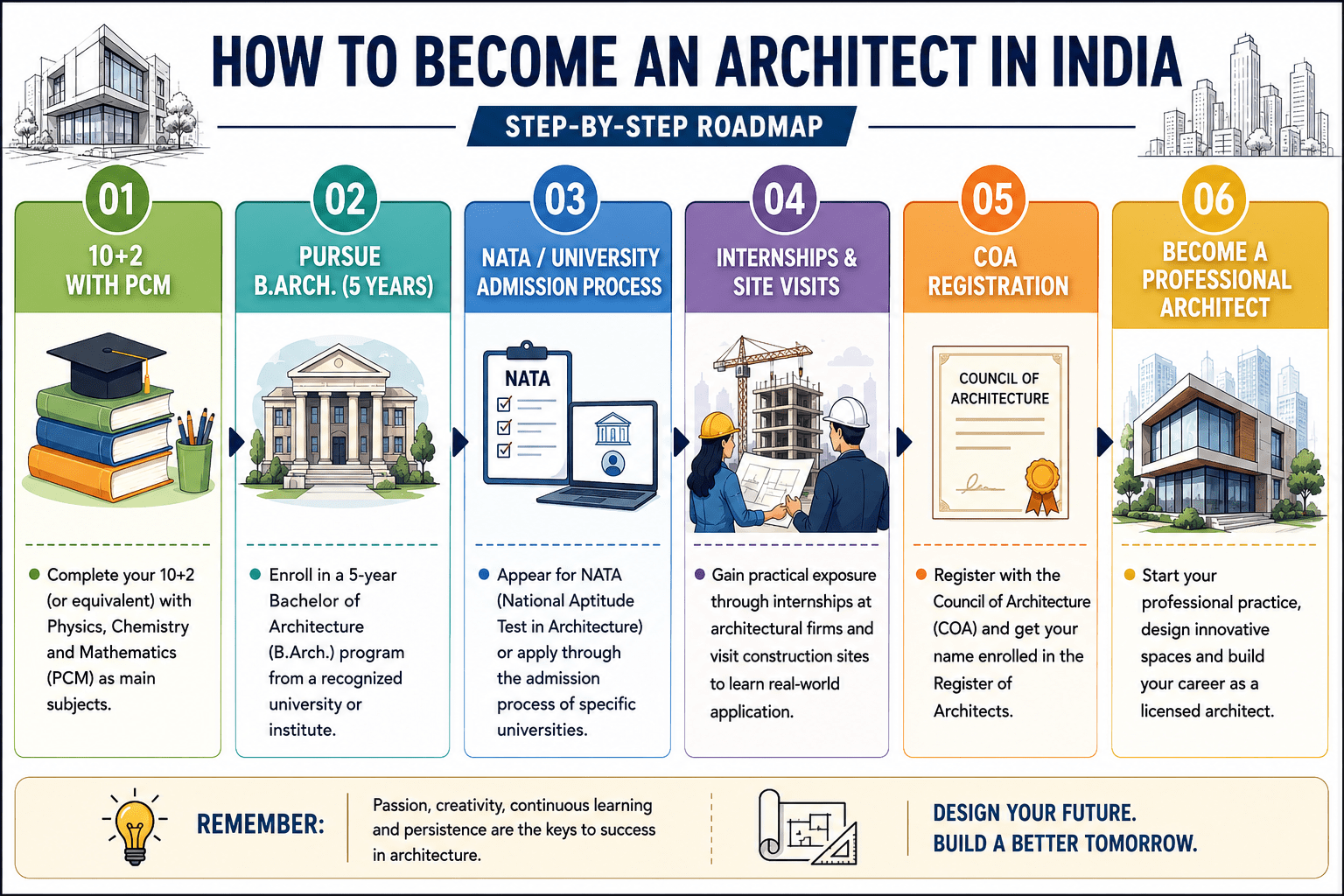
To become an architect in India, you will need to follow a specific educational and professional path. Here are the steps to become an architect after 12th grade:
Step 1. Choose the Science Stream in 10+2: In high school (10+2), select the science stream with physics, chemistry, mathematics, etc. as core subjects. An architecture course requires a strong foundation in these subjects.
Step 2. Pursue a Bachelor’s Degree in Architecture: After completing your 12th grade, you need to enrol in a bachelor’s degree programme in architecture (B.Arch.). An architect course is typically five years long. It’s offered by various government universities and top private universities is often based on entrance exams conducted by respective institutions or state-level examinations, such as the National Aptitude Test in Architecture (NATA).
NATA is one of the most recognised architecture entrance examinations in India. The examination evaluates:
- Drawing ability
- Visual perception
- Aesthetic sensitivity
- Logical reasoning
- Creative thinking
- Architectural awareness
Some universities have their own admission process for B.Arch. programmes; however, they may still offer scholarships or other benefits to students based on their NATA scores.
Step 3. Complete the Architecture Degree: While studying architecture, you will study various aspects of architecture, including design principles, construction techniques and computer-aided design (CAD) to get an architecture degree. You will also participate in studio projects and internships to gain practical experience.
Step 4. Gain Practical Exposure
Throughout the B.Arch. programme, students participate in architectural training, studio work, site visits, internships, and practical projects. These experiences help them understand real-world design, construction processes, and professional practice.
Step 5. Register with the Council of Architecture (COA): Once you have completed your practical training, you need to register with the Council of Architecture (COA). It’s a regulatory body for the architectural profession in India. You will need to submit the necessary documents and fulfil the registration requirements set by the COA. You will need to qualify for the architecture examination conducted by the COA. This exam assesses your knowledge and competency in architectural design, building regulations, and professional practice.
Postgraduate Studies (Optional Step): Although not mandatory, you may choose to pursue a postgraduate degree in architecture, such as a Master’s in Architecture (M.Arch.), to specialise in a specific area of interest or to gain advanced knowledge in the field.
B.Arch. Eligibility Criteria at a Glance
| Particular | Details |
|---|---|
| Course | Bachelor of Architecture (B.Arch.) |
| Duration | 5 Years |
| Qualification | 10+2 or 10+3 Diploma |
| Mandatory Subjects | Physics & Mathematics |
| Minimum Marks | 45% Aggregate |
| Entrance Exam | NATA (Preferred by most universities) |
| Course Type | Undergraduate |
Why Consider K.R. Mangalam University for Architecture?
Choosing the right architecture university can significantly influence your learning experience and career growth.
K.R. Mangalam University offers a Bachelor of Architecture programme. Here are the basic details of this programmes.
Duration: 5 Years
Annual Fee: ₹2,10,000 per year (latest admission page)
Eligibility:
- Passed 10+2 or equivalent examination.
- Physics and mathematics as compulsory subjects.
- One of the following subjects: chemistry, biology, computer science, information technology, engineering graphics, business studies, or a technical vocational subject.
- Minimum 45% aggregate marks.
- Candidates with a 10+3 diploma with mathematics and at least 45% marks are also eligible.
KRMU’s B.Arch. programme is well known because of:
NATA-Based Scholarships at K.R. Mangalam University
Students applying for the B.Arch. programme can also benefit from merit-based scholarships through their NATA scores. The university offers financial support to encourage talented and aspiring architects to pursue their education with greater ease
| NATA Score | Scholarship |
|---|---|
|
130.01 & above |
100% Scholarship |
| 110.01 – 130 |
35% Scholarship |
| 90 – 110 |
25% Scholarship |
Note: Students should refer to the latest admission brochure or contact the university admissions team for updated scholarship information.
Industry-Oriented Curriculum
Students learn architectural design, planning, construction, sustainability, and emerging technologies through a contemporary curriculum.
Studio-Based Learning
The programme emphasises design studios, model making, project-based learning, and practical application.
Modern Infrastructure
Students have access to design studios, digital learning resources, workshops, and technology-enabled learning environments.
Industry Exposure
Workshops, site visits, internships, and expert interactions help students understand real-world architectural practice.
Career Development Support
Students receive guidance through internships, portfolio development, skill-building initiatives, and career support activities.
Top Career Opportunities After Architecture Courses
India is one of the fastest-developing countries that require qualified professionals for roles such as:
| Career Options | Descriptions | Average Salary |
|---|---|---|
| Sustainable Architects | Sustainable architects design environmentally responsible buildings that minimise energy consumption, reduce waste, and promote sustainable construction practices. | ₹4 LPA – ₹10 LPA |
| Urban Planners | Urban planners develop plans for cities, towns, and communities by focusing on land use, transportation systems, housing, and sustainable urban development. | ₹5 LPA – ₹12 LPA |
| Landscape Architects | Landscape architects design outdoor spaces such as parks, gardens, campuses, waterfronts, and public spaces while balancing aesthetics and environmental considerations. | ₹4 LPA – ₹9 LPA |
| BIM Specialists | Building Information Modelling (BIM) specialists use digital technologies to create intelligent 3D models that support planning, design, construction, and facility management. | ₹5 LPA – ₹12 LPA |
| Interior Designers / Interior Architects | These professionals create functional, aesthetically appealing, and user-friendly interior spaces for residential, commercial, hospitality, and corporate projects. | ₹4 LPA – ₹10 LPA |
| Smart City Consultants | Smart city consultants work on technology-enabled urban infrastructure projects involving mobility, sustainability, digital governance, and urban innovation. | ₹6 LPA – ₹15 LPA |
| Green Building Consultants | Green building consultants advise developers and organisations on sustainable design practices, energy efficiency, environmental compliance, and green building certifications. | ₹5 LPA – ₹12 LPA |
| Architectural Visualisers | Architectural visualisers create realistic 3D renderings, walkthroughs, animations, and digital presentations that help clients visualise their projects before construction. | ₹4 LPA – ₹9 LPA |
| Computational Designers | Computational designers use advanced software, coding, and parametric design tools to develop innovative architectural forms and optimise building performance. | ₹6 LPA – ₹15 LPA |
| Set Designer | Set designers create visual environments for films, television, theatre productions, exhibitions, events, and commercial shoots. | ₹4 LPA – ₹10 LPA |
| Real Estate Design Consultants | Real estate design consultants work with developers and property firms to optimise project design, functionality, aesthetics, marketability, and user experience. | ₹5 LPA – ₹12 LPA |
Top Recruiters Hiring Architecture Graduates
Architecture graduates find opportunities across private firms, government organisations, infrastructure companies, and international design consultancies. Some leading recruiters include:
- L&T Construction
- Shapoorji Pallonji
- DLF
- Godrej Properties
- CBRE
- Cushman & Wakefield
- Hafeez Contractor
- CP Kukreja Architects
- Morphogenesis
- GMR Group
- Tata Projects
- AECOM
Many graduates also establish independent architecture and interior design practices after gaining professional experience.
Conclusion
Architecture is much more than designing buildings—it is about shaping the spaces, cities, and communities where people live, work, and interact. With India’s rapid urbanisation, infrastructure expansion, smart city initiatives, and a growing focus on sustainable development, the demand for skilled architects continues to evolve across diverse sectors.
The journey to becoming an architect requires creativity, technical knowledge, practical exposure, and continuous learning. From pursuing a B.Arch. degree and gaining hands-on experience to exploring specialised careers in urban planning, sustainable design, BIM, and smart city development, architecture offers a wide range of rewarding opportunities.
For aspiring architects looking to build a strong foundation, K.R. Mangalam University provides industry-orientated learning, studio-based education, practical exposure, and career development support to help students prepare for the future of the profession.
Ready to turn your creativity into a career?
Explore the B.Arch. programme at K.R. Mangalam University and take the first step towards becoming a future-ready architect.
An architecture course focuses on designing buildings and spaces while combining creativity, technical knowledge, and practical skills. You must choose the Science stream with Physics, Chemistry, and Mathematics (PCM) in 10+2. Common entrance exams include NATA and JEE Main Paper 2. A Bachelor of Architecture (B.Arch) typically takes 5 years to complete. Yes, you must register with the Council of Architecture to practice legally.FAQs
What is an architecture course?
What stream should I choose after 10th to become an architect?
Which entrance exams are required for architecture in India?
How long does it take to become an architect?
Is registration mandatory to practice as an architect in India?
Recent Post
Best Courses After 12th in India 2027: Science, Commerce & Arts
Mental Health Awareness: Importance, Signs & Support in India
GATE Registration 2027: Eligibility, Dates & Complete Process!
Best Interior Design Universities in Delhi NCR: Choose the Right One!
B.Tech. AI ML Universities in Delhi NCR: Choose the Right One
B.Tech. Data Science vs B.Tech. Cyber Security: What’s Best in 2026?
B.A. English Honors Course Admission, Eligibility & Career Scope
BCA Course After 12th: Best College, Fees, Curriculum and More
Top Engineering Colleges in Gurgaon: Admission, Fees & Placement Guide
Best University in Delhi NCR, Haryana: Admissions & Fees Guide
CUET PG Study Plan 2026: Exam Pattern, Duration & Key Tips!
How to Become a Journalist: Skills, Courses, Salary & Career Path
Know the Difference Between B.A. LL.B. and B.A. LL.B. Hons.!
Entrepreneurship Development Programme: Meaning, Objectives & Need
CTET Exam Date 2026: Eligibility, Syllabus, Pattern & Admit Card
Career Options After BSc Physics Honours: Top Jobs & Salary Guide
Scope of Political Science: Importance, Career Options & Courses
All India Forensic Science Entrance Test (AIFSET-2026) Details and Eligibility
Explore the Top Artificial Intelligence University in India
BBA HR Management Syllabus: Semester-Wise Detailed Curriculum
Best AI Colleges in India: Fees, Admissions & Placement Insights
Top B.Tech. Universities in Delhi: Rankings, Fees & Admission
Explore the Best Courses After Graduation for High Salary
BSc Data Science: Syllabus, Careers, and Data Science Course
Understanding the Difference Between Logistics and Supply Chain Management
Is Data Science a Good Career Choice? Salary, Scope & Future Growth Explained
Integrated Course After 12th: Complete Guide, List and Benefits
Moot Court for Law Students: Its Importance and Objectives
CAT 2025: Exam Date, Eligibility, Syllabus, Registration & Preparation Tips
Career Guidance and Counselling: Expert Support for a Successful Future
Importance of Internships: Boost Your Career with Real-World Experience
What to Do After CUET Result: Courses, Counselling & Admission Process
CUET Result 2025 Out: Check Scores, Cut-Offs & What to Do Next
Explore the Best College for MBA in Marketing in Delhi NCR
Pursue Bachelor’s Degree in Journalism & Mass Communication at KRMU
BCA Course After 12th: Eligibility, Fees, Career Scope & Admission Guide
BBA in Digital Marketing: Eligibility, Subjects, Fee and Scope
Ph.D. in Mechanical Engineering: Eligibility, Admission and Fee Details
D Pharmacy Admission: Eligibility, Fees, Syllabus & Career Scope
Is B.Sc. Computer Science Worth It? Salary, Scope & Future Prospects
GMAT Exam 2025: Eligibility, Syllabus, Exam Pattern and More
KRMU: The Destination to Become a Future-Ready Software Engineer
Ph.D. Pharmaceutical Sciences: Course Details and Admission Process
Why KRMU is the Best College for BCom Hons. in Gurugram, Delhi NCR
JEE Mains 2025 Exam Date: Syllabus, Last date, Registration Date
Career After MA English: High Paying Jobs and Government Roles
Why K.R. Mangalam University Is The Best Fine Arts University in India?
Navigating The Law Careers: Options, Opportunities, and Insights
Benefits of a Culinary Arts Bachelor Degree for Aspiring Chefs
Architecture Careers In India: Your Path To A Successful Future
Is NTA CUET UG Score Mandatory For Admission In All Universities
Data Science and Artificial Intelligence: Revolutionising the Digital Age
Exploring Top Career Options For Commerce Students After The 12th
Exploring The Best Course After B Com To Elevate Future Prospects
The Difference between BE and BTech: Everything you need to know
Exploring Jobs After BSc Chemistry: Private And Government Jobs
Best Professional Courses After 12th for a High-Paying Career
Why KRMU Is Considered One Of The Best BSc Agriculture Colleges In India?
A Complete Guide On Full Stack Development: Career Paths/Eligibility/Duration
Why KRMU Is Considered One Of The Best Hotel Management Colleges In India
Hotel Management Course Fees in Private College: What You Need to Know
Everything You Need to Know About Integrating Dual Degree Programs
Textile Design Course, Eligibility and Career Opportunities
Physiotherapy Course Fees: Career Paths/Eligibility Criteria/Top Colleges
Exploring BJMC Colleges in Delhi: Your Comprehensive Guide
Difference Between B.Sc. And B.Sc. Hons.: Which One Is Better?
A Comprehensive Guide B Pharm Duration, Syllabus, Job Opportunities
Pharmacokinetics in action: the science behind drug dynamics
BCA Full Form And Subjects- Comprehensive Understanding Of BCA
Complete Guide of B Sc Agriculture Course Duration, Admission Process, Fees
A Detailed Guide On How To Become A Fashion Designer After 12th
Navigating Sustainability Trends: Preparing Students for Corporate Priorities in 2024
List Of Top Career Options After B.Tech Computer Science & Engineering
How to Choose the Right 12th Commerce Courses for Your Salary?
Local tourism: Key to unlocking India’s huge tourism ecosystem
K.R. Mangalam University: A Leading University For Comprehensive Excellence
Understanding BBA Travel & Tourism: A Gateway To A Thriving Future
Why Choose B Tech Cyber Security: Learn Eligibility/Benefits/Career/College
Benefits of Pursuing An MBA After BA: Career/Specialisations/Entrance Exam
Exploring the UX/UI Race in B.Tech. Computer Science & Engineering
BBA in Human Resources: A Strategic Move for Future HR Leaders
Exploring the UX/UI Race in B.Tech. Computer Science & Engineering
B.Tech Computer Science Course: Eligibility, Syllabus, Exams, Fees, Scope
Exploring a BBA in Finance: Your Comprehensive Guide to a Promising Career Path
Compelling Reasons to Choose a BBA Program in Travel and Tourism
BA Political Science Honours: Your Path to Political Insight
Beyond Fashion Designing: Exploring the Creative World of B.A. Arts
Unlocking the Path to Success: Your Thriving Career in Cyber Security
B.Sc. Forensic Science Course: Eligibility, Scope & Top Jobs
The Art of Public Speaking: Tips for Confident Presentations
Advancing Your Career: Pursuing Diploma Courses After 10th Grade
Computer Science Engineering: Unraveling the Realm of Technology and Innovation
The Ultimate Guide to Choosing the Right Data Science Course for Your Career
Internship and Practical Training Opportunities for B.Com (Honours) Students
Exploring Career Scope of Pharmacology: A Promising Pathway
The Rise of Fintech: Revolutionizing India’s Financial Landscape
The Advancement Postgraduate Courses in India Career Development
Understanding the Difference Between Psychologist and Psychiatrist
Career in Fashion Designing: Full Guide from Start to Destination
Exploring a Career in Criminal Law: An In-Depth Guide to LLB Criminal Law
Unveiling the Role of a Supply Chain Analyst: A Path to Success
Comparing CSE and IT: Unveiling Distinctions and Career Opportunities
Exploring the Educational Landscape: Top Universities in Gurgaon
Traditional Marketing vs Digital Marketing: Exploring their Pros and Cons
The Basics of B Tech: What You Need to Know to Pursue a Degree in Technology
How To Become An Interior Designer in India: Qualification & Career Scopes
Exploring the Benefits of an International Accounting and Finance Course
BA LLB (Hons): A Comprehensive Guide to Understanding the Program
5 Full Stack Web Development Course Lessons from the Professionals
Training the future educators at the Best B.Ed College in Gurgaon
Gain Exceptional Business Expertise with Best B-School in Gurgaon
Best Undergraduate Courses to Study in India for a Promising Career
Unleashing Creativity and Empowering Dreams: Why Pursue Architecture program after 12th
CTET 2023: Registration details for Central Teacher Eligibility Test
Develop Forensics Expertise with Best BSc Forensic Science Course in Delhi
Best BSc Hons Mathematics Scope: Career Options and Responsibilities
Best Courses After 12th Commerce – Professional Programmes & More
A Detailed Overview of Best Journalism Courses After 12th
Integrated BBA MBA Course Details, Eligibility and Career options
BBA LLB Hons: Admission, Eligibility, Subjects, Scope and Jobs
What should You Do after completing BA in Political Science (honors)
Why studying Machine learning is a good career option after 12th
Ultimate Guide to CAT Exam: Admit card, Exam Date, Syllabus and Preparations
BA Honours in English: Course Details, Syllabus, Eligibility and Career Options
Career and Scopes after BCA with Artificial Intelligence and Data Science
Which Course Should I Choose After Completing 12th from Arts Stream?
Why choose MCA: Course details, Eligibility, Benefits, Career Options and Salary
Career, Scopes and Salary after B.Tech CSE with Specialisation in Cloud Computing
Career and Opportunities after completing your B.Tech Civil Engineering
What are the advantages of pursuing a B.Tech. in (CSE) with specialization in UX/UI
Can a PCB Student do B.Tech in Computer Science Engineering
Why pursuing a BA (Hons.) – Chinese Degree can be a good choice for you?
Top Soft Skills That You Need to Develop for a Successful Career
Why Choose B.Tech. Mechanical Engineering after Class 12?
How to Choose the Best Career Path: Machine Learning Engineer or Data Scientist
Top 20 Things Architects Can Do After B.Arch in India: A Must Read!
Get Better Job Opportunities with the Help of Top Colleges for MCA in Delhi NCR
K.R. Mangalam University Gears up to Sign MoU with Sputnik News Agency, Moscow
How Is Artificial Intelligence Shaping The Pharmacy Industry Of Today
The Emergence Of E-Commerce And E-Business In The Post-Pandemic World
The Role And Contribution Of Chemists In Improving The Overall Healthcare Scenario
5 Best Paying Jobs For Journalism & Mass Communicationgraduates
Clinical Psychology – Career Scope & Earning Potential In India
Challenges & Opportunities For Fashion Designers In The Post Covid World
The Invincible Role Of Medical & Allied Sciences Professionals Amid The Covid Crisis
The Emerging Role Of Information Technology In The Field Of Journalism
Indian Pharma Growing As The Largest Sector In Terms Of Employment & Revenue
Covid-19 Projects At KRMU: An Effort To Raise Awareness Among The Young Gen
Cybersecurity: A Much Sought-After Profession In Today’s Technology Oriented World
The Worth Of Industry-Vetted Management Training In 21st-Century Corporate World
Understanding The Twenty-First-Century Entrepreneurial Challenges
Why The World Of Fashion Needs Trendsetters Rather Than Followers?
Technological Trends Changing The Face Of Architecture Today
5 Significant Ways In Which The Industry Of Journalism Has Evolved Over The Years
Acquiring The Right Workforce Is The Key Requirement For Meeting Business Goals
The Vitality Of Application & Research-Based Learning For The 21st-Century Youth
Need for Legal, Administrative & Judicial Reforms in India
How Will The Current Pandemic Change The Fashion Industry Worldwide?
Business Journalism – An Emerging Career Path For The 21st Century Youth
The Growing Use Of Business Analytics In Financial Services Industry
5 Tips For Beginners To Survive & Thrive In The Fashion Industry
Five Skills You Inevitably Need To Succeed As An Interior Designer
How Is The Advancing Technology Redesigning The Fashion Design Industry?
Top Technical Skills That Are Highly Demanded in The Modern Job Market
Soil Science – Career Potential & Opportunities In India And Abroad
Key Skills You Need To Thrive In The Domain Of Hotel Management
The Role Of KRMU ICC In Establishing A Safe & Secure Environment In The Campus
What It Takes To Grab The Best Jobs In The Fashion Design World?
K.R. Mangalam – Building A Generation Of Creative Fashion Designers
International Exposure Is Crucial For Ensuring Professional Success In The Global Market
What Makes Project-Based Learning Imperative For The Youth Of Today
KRMU’s Engineering Kitchen Inspiring The Youth To Shape A New World Of Innovation
Experiential Projects – An Effective Way To Deep Rooted Management Education
KRMU’s Corporate Connect Aiding Students To Prove Their Mettle
Learn The True Art Of Innovation & Entrepreneurship At KRMU’s TIIE
KRMU To Establish A fully Functional Robotics Lab In Collaboration With IITBombay
Explore Engineering Kitchen – An Excellent Initiative Taken By KRMU
5 Reasons Why You Should Pursue A Degree In Journalism And Mass Communication
The Impact Of Artificial Intelligence And Iot On The Management Industry
Diverse Engineering Branches That Have Always Maintained Their Worth
Career Options That Will Be High In Demand In The Next Decade
KRMU – Creating A Culture Of Knowledge, Entrepreneurship, And Management Skills
Effective Marketing Management Can Help To Raise The Overall Value Of A Business
5 Invaluable Steps For Building An Excellent Professional Network
Priceless Qualities A Successful Legal Practitioner Needs To Treasure
Better Grades, Less Stress At School Of Law, K.R Mangalam University,Gurugram
Aesthetic And Logic, The Conflict Between Religion And Humanism In 21st Century
Best Ways For MBA Aspirants To Upgrade Their Communication Skills
How To Know If Journalism Is The Right Career Option For You
Tradition And Modernity Living Historical Quarters: Change And Continuity
Legal Profession One Of The Most Sought After Career Choices For Women Today
Dynamic Career Opportunities In Journalism Cultivated By Modern India
How Can Virtual Reality Help Pave Way For Transforming Architecture Education?
Top Questions Asked To Management Graduates In Placement Interviews
Wish To Make A Career In Ethical Hacking? Here’s All You Need To Know!
Future Career Perspectives Of Technical Education In India And Abroad
Why Is Personality Development An Utmost Need For Professional Success?
KRMU’S School Of Law – Strengthening The Legal Framework Of The Nation
The Importance Of Technology As A Teaching Aid In Higher Education
Top Business Lessons To Learn From Successful Businessmen From Across The World
Grooming The Students For The Current Trends In Medical And Allied Sciences
The Need For Skills Enhancement For The Competitive Corporate World
Tapping The Career Growth And Overseas Opportunities For Management Graduates
Significance Of Mentoring Programs Towards Holistic Development Of Students
KRMU – Delivering Education That Enables You To Lead The Competition
How to Become an Architect in India?: Full Roadmap
Architecture remains one of the few professions that blends design, engineering, sustainability, technology, and urban development into a single career path. As India’s cities continue to expand and infrastructure projects grow, the demand for qualified architects continues to evolve. If you have a passion for design, a keen eye for detail, and aesthetically pleasing spaces, an architecture programme could be a great fit for you. The B.Arch. programme is a 5-year undergraduate degree designed to develop creative, analytical, and technically skilled architects.
In this blog, aspirants get to learn how to become an architect in India.
Overview of This Blog
| Sections | Descriptions |
|---|---|
| Who Is an Architect? Role and Day-to-Day Responsibilities | Explains who architects are, their role in designing and planning spaces, and their key daily responsibilities such as design, drawings, site visits, client communication, and project coordination. |
| Why Is Architecture Becoming Increasingly Important? | Explains how architecture is connected to India’s growth in infrastructure, urban development, real estate, sustainability, and smart city projects, creating long-term demand for skilled architects. |
| How to Become an Architect in India? | Provides a step-by-step roadmap covering 10+2 requirements, B.Arch admission, NATA, architectural education, practical exposure, COA registration, and optional postgraduate studies. |
| B.Arch. Eligibility Criteria at a Glance | Information on this programme in a tabular form. |
| How Many Years It Takes: Full Timeline | Explains the typical 5-year B.Arch. pathway, including the course duration, practical training, and opportunities for higher studies. |
| Why Consider K.R. Mangalam University for Architecture? | Highlights the university’s B.Arch programme, eligibility criteria, fee structure, industry-orientated curriculum, studio-based learning, infrastructure, and career support. |
| Top Career Opportunities After Architecture Courses | Explores emerging career paths such as Sustainable Architect, Urban Planner, BIM Specialist, Smart City Consultant, Green Building Consultant, and more. |
| Conclusion | Summarises the career path in architecture and describes how K.R. Mangalam University may assist students in laying a solid basis for success in the workplace. |
Who Is an Architect? Role and Day-to-Day Responsibilities
An architect is a professional who plans, designs, and oversees the development of buildings and other physical spaces. Their work combines design, technical knowledge, creativity, and problem-solving to create spaces that are functional, safe, sustainable, and visually appealing.
Role of an Architect
- Design Planning: Develop concepts and designs based on the client’s requirements and project objectives.
- Technical Drawings: Prepare detailed architectural drawings, plans, and 3D models.
- Project Coordination: Work with engineers, contractors, interior designers, and other professionals.
- Site Visits: Inspect construction sites to monitor progress and ensure designs are followed.
- Client Communication: Discuss ideas, budgets, design changes, and project requirements with clients.
- Regulatory Compliance: Ensure projects follow relevant building codes, regulations, and safety standards.
Day-to-Day Responsibilities
An architect’s daily work may include designing layouts, reviewing drawings, attending client meetings, coordinating with project teams, visiting construction sites, preparing documentation, and making design modifications based on project requirements.
Write it after the “B.Arch. Eligibility Criteria at a Glance” section
How Many Years It Takes: Full Timeline
Becoming an architect generally takes 5 years after Class 12, including a 5-year B.Arch. programme. Students can then pursue internships, practical training, and professional registration as required. Those who choose higher studies, such as an M.Arch., may spend additional years developing advanced expertise.
Why Is Architecture Becoming Increasingly Important?
Aspirants should understand why architecture is becoming increasingly important before they learn how to become an architect.
Architecture is closely linked to some of India’s fastest-growing sectors, including infrastructure, urban development, real estate, sustainability, and smart city projects.
- India’s construction sector contributes nearly 9% of the country’s GDP and employs more than 70 million people, making it one of the largest employment-generating industries in the country.
- The value of construction activity contributing to India’s economy exceeded ₹15 trillion in 2024, reflecting continued investment in infrastructure and urban development.
- The government-backed National Infrastructure Pipeline (NIP) involves investments worth approximately US$1.5 trillion, creating long-term demand for architects, planners, designers, and construction professionals.
- India’s construction market is projected to grow substantially over the coming years, driven by smart cities, urban housing, transportation networks, commercial developments, and sustainable infrastructure projects.
Skills Every Architect Should Develop
Architects today need more than just design skills. Employers want people who can solve real problems too — using technology, sustainable practices, and good communication.
What skills matter most? Quite a few, actually:
- Creative thinking and visualisation
- Technical drawing and CAD software
- Building Information Modelling (BIM)
- Problem-solving and analytical skills
- Knowledge of construction materials
- Project management
- Communication and teamwork
- Sustainable design principles
- Attention to detail
- Time management
Build these during your B.Arch. programme, and internship chances go up. Long-term career growth follows, too.
Architect Salary in India (2026): Entry to Senior Level
An architect’s salary in India varies based on experience, skills, specialisation, location, employer, and project responsibilities. Entry-level professionals generally earn less, while salaries tend to increase with experience and expertise.
| Experience Level | Approx. Salary Range in India (2026) |
|---|---|
| Entry-Level Architect (0–2 years) | ₹3–5 LPA |
| Mid-Level Architect (3–7 years) | ₹5–10 LPA |
| Senior Architect (8+ years) | ₹10–20+ LPA |
| Principal/Lead Architect | ₹15–30+ LPA |
Note: The salary figures provided are approximate and can vary significantly across organisations and locations. Experienced architects and those in senior or leadership positions may earn considerably higher packages.
How to Become an Architect in India?
To become an architect in India, you will need to follow a specific educational and professional path. Here are the steps to become an architect after 12th grade:
Step 1. Choose the Science Stream in 10+2: In high school (10+2), select the science stream with physics, chemistry, mathematics, etc. as core subjects. An architecture course requires a strong foundation in these subjects.
Step 2. Pursue a Bachelor’s Degree in Architecture: After completing your 12th grade, you need to enrol in a bachelor’s degree programme in architecture (B.Arch.). An architect course is typically five years long. It’s offered by various government universities and top private universities is often based on entrance exams conducted by respective institutions or state-level examinations, such as the National Aptitude Test in Architecture (NATA).
NATA is one of the most recognised architecture entrance examinations in India. The examination evaluates:
- Drawing ability
- Visual perception
- Aesthetic sensitivity
- Logical reasoning
- Creative thinking
- Architectural awareness
Some universities have their own admission process for B.Arch. programmes; however, they may still offer scholarships or other benefits to students based on their NATA scores.
Step 3. Complete the Architecture Degree: While studying architecture, you will study various aspects of architecture, including design principles, construction techniques and computer-aided design (CAD) to get an architecture degree. You will also participate in studio projects and internships to gain practical experience.
Step 4. Gain Practical Exposure
Throughout the B.Arch. programme, students participate in architectural training, studio work, site visits, internships, and practical projects. These experiences help them understand real-world design, construction processes, and professional practice.
Step 5. Register with the Council of Architecture (COA): Once you have completed your practical training, you need to register with the Council of Architecture (COA). It’s a regulatory body for the architectural profession in India. You will need to submit the necessary documents and fulfil the registration requirements set by the COA. You will need to qualify for the architecture examination conducted by the COA. This exam assesses your knowledge and competency in architectural design, building regulations, and professional practice.
Postgraduate Studies (Optional Step): Although not mandatory, you may choose to pursue a postgraduate degree in architecture, such as a Master’s in Architecture (M.Arch.), to specialise in a specific area of interest or to gain advanced knowledge in the field.
B.Arch. Eligibility Criteria at a Glance
| Particular | Details |
|---|---|
| Course | Bachelor of Architecture (B.Arch.) |
| Duration | 5 Years |
| Qualification | 10+2 or 10+3 Diploma |
| Mandatory Subjects | Physics & Mathematics |
| Minimum Marks | 45% Aggregate |
| Entrance Exam | NATA (Preferred by most universities) |
| Course Type | Undergraduate |
Why Consider K.R. Mangalam University for Architecture?
Choosing the right architecture university can significantly influence your learning experience and career growth.
K.R. Mangalam University offers a Bachelor of Architecture programme. Here are the basic details of this programmes.
Duration: 5 Years
Annual Fee: ₹2,10,000 per year (latest admission page)
Eligibility:
- Passed 10+2 or equivalent examination.
- Physics and mathematics as compulsory subjects.
- One of the following subjects: chemistry, biology, computer science, information technology, engineering graphics, business studies, or a technical vocational subject.
- Minimum 45% aggregate marks.
- Candidates with a 10+3 diploma with mathematics and at least 45% marks are also eligible.
KRMU’s B.Arch. programme is well known because of:
NATA-Based Scholarships at K.R. Mangalam University
Students applying for the B.Arch. programme can also benefit from merit-based scholarships through their NATA scores. The university offers financial support to encourage talented and aspiring architects to pursue their education with greater ease
| NATA Score | Scholarship |
|---|---|
|
130.01 & above |
100% Scholarship |
| 110.01 – 130 |
35% Scholarship |
| 90 – 110 |
25% Scholarship |
Note: Students should refer to the latest admission brochure or contact the university admissions team for updated scholarship information.
Industry-Oriented Curriculum
Students learn architectural design, planning, construction, sustainability, and emerging technologies through a contemporary curriculum.
Studio-Based Learning
The programme emphasises design studios, model making, project-based learning, and practical application.
Modern Infrastructure
Students have access to design studios, digital learning resources, workshops, and technology-enabled learning environments.
Industry Exposure
Workshops, site visits, internships, and expert interactions help students understand real-world architectural practice.
Career Development Support
Students receive guidance through internships, portfolio development, skill-building initiatives, and career support activities.
Top Career Opportunities After Architecture Courses
India is one of the fastest-developing countries that require qualified professionals for roles such as:
| Career Options | Descriptions | Average Salary |
|---|---|---|
| Sustainable Architects | Sustainable architects design environmentally responsible buildings that minimise energy consumption, reduce waste, and promote sustainable construction practices. | ₹4 LPA – ₹10 LPA |
| Urban Planners | Urban planners develop plans for cities, towns, and communities by focusing on land use, transportation systems, housing, and sustainable urban development. | ₹5 LPA – ₹12 LPA |
| Landscape Architects | Landscape architects design outdoor spaces such as parks, gardens, campuses, waterfronts, and public spaces while balancing aesthetics and environmental considerations. | ₹4 LPA – ₹9 LPA |
| BIM Specialists | Building Information Modelling (BIM) specialists use digital technologies to create intelligent 3D models that support planning, design, construction, and facility management. | ₹5 LPA – ₹12 LPA |
| Interior Designers / Interior Architects | These professionals create functional, aesthetically appealing, and user-friendly interior spaces for residential, commercial, hospitality, and corporate projects. | ₹4 LPA – ₹10 LPA |
| Smart City Consultants | Smart city consultants work on technology-enabled urban infrastructure projects involving mobility, sustainability, digital governance, and urban innovation. | ₹6 LPA – ₹15 LPA |
| Green Building Consultants | Green building consultants advise developers and organisations on sustainable design practices, energy efficiency, environmental compliance, and green building certifications. | ₹5 LPA – ₹12 LPA |
| Architectural Visualisers | Architectural visualisers create realistic 3D renderings, walkthroughs, animations, and digital presentations that help clients visualise their projects before construction. | ₹4 LPA – ₹9 LPA |
| Computational Designers | Computational designers use advanced software, coding, and parametric design tools to develop innovative architectural forms and optimise building performance. | ₹6 LPA – ₹15 LPA |
| Set Designer | Set designers create visual environments for films, television, theatre productions, exhibitions, events, and commercial shoots. | ₹4 LPA – ₹10 LPA |
| Real Estate Design Consultants | Real estate design consultants work with developers and property firms to optimise project design, functionality, aesthetics, marketability, and user experience. | ₹5 LPA – ₹12 LPA |
Top Recruiters Hiring Architecture Graduates
Architecture graduates find opportunities across private firms, government organisations, infrastructure companies, and international design consultancies. Some leading recruiters include:
- L&T Construction
- Shapoorji Pallonji
- DLF
- Godrej Properties
- CBRE
- Cushman & Wakefield
- Hafeez Contractor
- CP Kukreja Architects
- Morphogenesis
- GMR Group
- Tata Projects
- AECOM
Many graduates also establish independent architecture and interior design practices after gaining professional experience.
Conclusion
Architecture is much more than designing buildings—it is about shaping the spaces, cities, and communities where people live, work, and interact. With India’s rapid urbanisation, infrastructure expansion, smart city initiatives, and a growing focus on sustainable development, the demand for skilled architects continues to evolve across diverse sectors.
The journey to becoming an architect requires creativity, technical knowledge, practical exposure, and continuous learning. From pursuing a B.Arch. degree and gaining hands-on experience to exploring specialised careers in urban planning, sustainable design, BIM, and smart city development, architecture offers a wide range of rewarding opportunities.
For aspiring architects looking to build a strong foundation, K.R. Mangalam University provides industry-orientated learning, studio-based education, practical exposure, and career development support to help students prepare for the future of the profession.
Ready to turn your creativity into a career?
Explore the B.Arch. programme at K.R. Mangalam University and take the first step towards becoming a future-ready architect.
An architecture course focuses on designing buildings and spaces while combining creativity, technical knowledge, and practical skills. You must choose the Science stream with Physics, Chemistry, and Mathematics (PCM) in 10+2. Common entrance exams include NATA and JEE Main Paper 2. A Bachelor of Architecture (B.Arch) typically takes 5 years to complete. Yes, you must register with the Council of Architecture to practice legally.FAQs
What is an architecture course?
What stream should I choose after 10th to become an architect?
Which entrance exams are required for architecture in India?
How long does it take to become an architect?
Is registration mandatory to practice as an architect in India?
Recent Post
Best Courses After 12th in India 2027: Science, Commerce & Arts
Mental Health Awareness: Importance, Signs & Support in India
GATE Registration 2027: Eligibility, Dates & Complete Process!
Best Interior Design Universities in Delhi NCR: Choose the Right One!
B.Tech. AI ML Universities in Delhi NCR: Choose the Right One
B.Tech. Data Science vs B.Tech. Cyber Security: What’s Best in 2026?
B.A. English Honors Course Admission, Eligibility & Career Scope
BCA Course After 12th: Best College, Fees, Curriculum and More
Top Engineering Colleges in Gurgaon: Admission, Fees & Placement Guide
Best University in Delhi NCR, Haryana: Admissions & Fees Guide
CUET PG Study Plan 2026: Exam Pattern, Duration & Key Tips!
How to Become a Journalist: Skills, Courses, Salary & Career Path
Know the Difference Between B.A. LL.B. and B.A. LL.B. Hons.!
Entrepreneurship Development Programme: Meaning, Objectives & Need
CTET Exam Date 2026: Eligibility, Syllabus, Pattern & Admit Card
Career Options After BSc Physics Honours: Top Jobs & Salary Guide
Scope of Political Science: Importance, Career Options & Courses
All India Forensic Science Entrance Test (AIFSET-2026) Details and Eligibility
Explore the Top Artificial Intelligence University in India
BBA HR Management Syllabus: Semester-Wise Detailed Curriculum
Best AI Colleges in India: Fees, Admissions & Placement Insights
Top B.Tech. Universities in Delhi: Rankings, Fees & Admission
Explore the Best Courses After Graduation for High Salary
BSc Data Science: Syllabus, Careers, and Data Science Course
Understanding the Difference Between Logistics and Supply Chain Management
Is Data Science a Good Career Choice? Salary, Scope & Future Growth Explained
Integrated Course After 12th: Complete Guide, List and Benefits
Moot Court for Law Students: Its Importance and Objectives
CAT 2025: Exam Date, Eligibility, Syllabus, Registration & Preparation Tips
Career Guidance and Counselling: Expert Support for a Successful Future
Importance of Internships: Boost Your Career with Real-World Experience
What to Do After CUET Result: Courses, Counselling & Admission Process
CUET Result 2025 Out: Check Scores, Cut-Offs & What to Do Next
Explore the Best College for MBA in Marketing in Delhi NCR
Pursue Bachelor’s Degree in Journalism & Mass Communication at KRMU
BCA Course After 12th: Eligibility, Fees, Career Scope & Admission Guide
BBA in Digital Marketing: Eligibility, Subjects, Fee and Scope
Ph.D. in Mechanical Engineering: Eligibility, Admission and Fee Details
D Pharmacy Admission: Eligibility, Fees, Syllabus & Career Scope
Is B.Sc. Computer Science Worth It? Salary, Scope & Future Prospects
GMAT Exam 2025: Eligibility, Syllabus, Exam Pattern and More
KRMU: The Destination to Become a Future-Ready Software Engineer
Ph.D. Pharmaceutical Sciences: Course Details and Admission Process
Why KRMU is the Best College for BCom Hons. in Gurugram, Delhi NCR
JEE Mains 2025 Exam Date: Syllabus, Last date, Registration Date
Career After MA English: High Paying Jobs and Government Roles
Why K.R. Mangalam University Is The Best Fine Arts University in India?
Navigating The Law Careers: Options, Opportunities, and Insights
Benefits of a Culinary Arts Bachelor Degree for Aspiring Chefs
Architecture Careers In India: Your Path To A Successful Future
Is NTA CUET UG Score Mandatory For Admission In All Universities
Data Science and Artificial Intelligence: Revolutionising the Digital Age
Exploring Top Career Options For Commerce Students After The 12th
Exploring The Best Course After B Com To Elevate Future Prospects
The Difference between BE and BTech: Everything you need to know
Exploring Jobs After BSc Chemistry: Private And Government Jobs
Best Professional Courses After 12th for a High-Paying Career
Why KRMU Is Considered One Of The Best BSc Agriculture Colleges In India?
A Complete Guide On Full Stack Development: Career Paths/Eligibility/Duration
Why KRMU Is Considered One Of The Best Hotel Management Colleges In India
Hotel Management Course Fees in Private College: What You Need to Know
Everything You Need to Know About Integrating Dual Degree Programs
Textile Design Course, Eligibility and Career Opportunities
Physiotherapy Course Fees: Career Paths/Eligibility Criteria/Top Colleges
Exploring BJMC Colleges in Delhi: Your Comprehensive Guide
Difference Between B.Sc. And B.Sc. Hons.: Which One Is Better?
A Comprehensive Guide B Pharm Duration, Syllabus, Job Opportunities
Pharmacokinetics in action: the science behind drug dynamics
BCA Full Form And Subjects- Comprehensive Understanding Of BCA
Complete Guide of B Sc Agriculture Course Duration, Admission Process, Fees
A Detailed Guide On How To Become A Fashion Designer After 12th
Navigating Sustainability Trends: Preparing Students for Corporate Priorities in 2024
List Of Top Career Options After B.Tech Computer Science & Engineering
How to Choose the Right 12th Commerce Courses for Your Salary?
Local tourism: Key to unlocking India’s huge tourism ecosystem
K.R. Mangalam University: A Leading University For Comprehensive Excellence
Understanding BBA Travel & Tourism: A Gateway To A Thriving Future
Why Choose B Tech Cyber Security: Learn Eligibility/Benefits/Career/College
Benefits of Pursuing An MBA After BA: Career/Specialisations/Entrance Exam
Exploring the UX/UI Race in B.Tech. Computer Science & Engineering
BBA in Human Resources: A Strategic Move for Future HR Leaders
Exploring the UX/UI Race in B.Tech. Computer Science & Engineering
B.Tech Computer Science Course: Eligibility, Syllabus, Exams, Fees, Scope
Exploring a BBA in Finance: Your Comprehensive Guide to a Promising Career Path
Compelling Reasons to Choose a BBA Program in Travel and Tourism
BA Political Science Honours: Your Path to Political Insight
Beyond Fashion Designing: Exploring the Creative World of B.A. Arts
Unlocking the Path to Success: Your Thriving Career in Cyber Security
B.Sc. Forensic Science Course: Eligibility, Scope & Top Jobs
The Art of Public Speaking: Tips for Confident Presentations
Advancing Your Career: Pursuing Diploma Courses After 10th Grade
Computer Science Engineering: Unraveling the Realm of Technology and Innovation
The Ultimate Guide to Choosing the Right Data Science Course for Your Career
Internship and Practical Training Opportunities for B.Com (Honours) Students
Exploring Career Scope of Pharmacology: A Promising Pathway
The Rise of Fintech: Revolutionizing India’s Financial Landscape
The Advancement Postgraduate Courses in India Career Development
Understanding the Difference Between Psychologist and Psychiatrist
Career in Fashion Designing: Full Guide from Start to Destination
Exploring a Career in Criminal Law: An In-Depth Guide to LLB Criminal Law
Unveiling the Role of a Supply Chain Analyst: A Path to Success
Comparing CSE and IT: Unveiling Distinctions and Career Opportunities
Exploring the Educational Landscape: Top Universities in Gurgaon
Traditional Marketing vs Digital Marketing: Exploring their Pros and Cons
The Basics of B Tech: What You Need to Know to Pursue a Degree in Technology
How To Become An Interior Designer in India: Qualification & Career Scopes
Exploring the Benefits of an International Accounting and Finance Course
BA LLB (Hons): A Comprehensive Guide to Understanding the Program
5 Full Stack Web Development Course Lessons from the Professionals
Training the future educators at the Best B.Ed College in Gurgaon
Gain Exceptional Business Expertise with Best B-School in Gurgaon
Best Undergraduate Courses to Study in India for a Promising Career
Unleashing Creativity and Empowering Dreams: Why Pursue Architecture program after 12th
CTET 2023: Registration details for Central Teacher Eligibility Test
Develop Forensics Expertise with Best BSc Forensic Science Course in Delhi
Best BSc Hons Mathematics Scope: Career Options and Responsibilities
Best Courses After 12th Commerce – Professional Programmes & More
A Detailed Overview of Best Journalism Courses After 12th
Integrated BBA MBA Course Details, Eligibility and Career options
BBA LLB Hons: Admission, Eligibility, Subjects, Scope and Jobs
What should You Do after completing BA in Political Science (honors)
Why studying Machine learning is a good career option after 12th
Ultimate Guide to CAT Exam: Admit card, Exam Date, Syllabus and Preparations
BA Honours in English: Course Details, Syllabus, Eligibility and Career Options
Career and Scopes after BCA with Artificial Intelligence and Data Science
Which Course Should I Choose After Completing 12th from Arts Stream?
Why choose MCA: Course details, Eligibility, Benefits, Career Options and Salary
Career, Scopes and Salary after B.Tech CSE with Specialisation in Cloud Computing
Career and Opportunities after completing your B.Tech Civil Engineering
What are the advantages of pursuing a B.Tech. in (CSE) with specialization in UX/UI
Can a PCB Student do B.Tech in Computer Science Engineering
Why pursuing a BA (Hons.) – Chinese Degree can be a good choice for you?
Top Soft Skills That You Need to Develop for a Successful Career
Why Choose B.Tech. Mechanical Engineering after Class 12?
How to Choose the Best Career Path: Machine Learning Engineer or Data Scientist
Top 20 Things Architects Can Do After B.Arch in India: A Must Read!
Get Better Job Opportunities with the Help of Top Colleges for MCA in Delhi NCR
K.R. Mangalam University Gears up to Sign MoU with Sputnik News Agency, Moscow
How Is Artificial Intelligence Shaping The Pharmacy Industry Of Today
The Emergence Of E-Commerce And E-Business In The Post-Pandemic World
The Role And Contribution Of Chemists In Improving The Overall Healthcare Scenario
5 Best Paying Jobs For Journalism & Mass Communicationgraduates
Clinical Psychology – Career Scope & Earning Potential In India
Challenges & Opportunities For Fashion Designers In The Post Covid World
The Invincible Role Of Medical & Allied Sciences Professionals Amid The Covid Crisis
The Emerging Role Of Information Technology In The Field Of Journalism
Indian Pharma Growing As The Largest Sector In Terms Of Employment & Revenue
Covid-19 Projects At KRMU: An Effort To Raise Awareness Among The Young Gen
Cybersecurity: A Much Sought-After Profession In Today’s Technology Oriented World
The Worth Of Industry-Vetted Management Training In 21st-Century Corporate World
Understanding The Twenty-First-Century Entrepreneurial Challenges
Why The World Of Fashion Needs Trendsetters Rather Than Followers?
Technological Trends Changing The Face Of Architecture Today
5 Significant Ways In Which The Industry Of Journalism Has Evolved Over The Years
Acquiring The Right Workforce Is The Key Requirement For Meeting Business Goals
The Vitality Of Application & Research-Based Learning For The 21st-Century Youth
Need for Legal, Administrative & Judicial Reforms in India
How Will The Current Pandemic Change The Fashion Industry Worldwide?
Business Journalism – An Emerging Career Path For The 21st Century Youth
The Growing Use Of Business Analytics In Financial Services Industry
5 Tips For Beginners To Survive & Thrive In The Fashion Industry
Five Skills You Inevitably Need To Succeed As An Interior Designer
How Is The Advancing Technology Redesigning The Fashion Design Industry?
Top Technical Skills That Are Highly Demanded in The Modern Job Market
Soil Science – Career Potential & Opportunities In India And Abroad
Key Skills You Need To Thrive In The Domain Of Hotel Management
The Role Of KRMU ICC In Establishing A Safe & Secure Environment In The Campus
What It Takes To Grab The Best Jobs In The Fashion Design World?
K.R. Mangalam – Building A Generation Of Creative Fashion Designers
International Exposure Is Crucial For Ensuring Professional Success In The Global Market
What Makes Project-Based Learning Imperative For The Youth Of Today
KRMU’s Engineering Kitchen Inspiring The Youth To Shape A New World Of Innovation
Experiential Projects – An Effective Way To Deep Rooted Management Education
KRMU’s Corporate Connect Aiding Students To Prove Their Mettle
Learn The True Art Of Innovation & Entrepreneurship At KRMU’s TIIE
KRMU To Establish A fully Functional Robotics Lab In Collaboration With IITBombay
Explore Engineering Kitchen – An Excellent Initiative Taken By KRMU
5 Reasons Why You Should Pursue A Degree In Journalism And Mass Communication
The Impact Of Artificial Intelligence And Iot On The Management Industry
Diverse Engineering Branches That Have Always Maintained Their Worth
Career Options That Will Be High In Demand In The Next Decade
KRMU – Creating A Culture Of Knowledge, Entrepreneurship, And Management Skills
Effective Marketing Management Can Help To Raise The Overall Value Of A Business
5 Invaluable Steps For Building An Excellent Professional Network
Priceless Qualities A Successful Legal Practitioner Needs To Treasure
Better Grades, Less Stress At School Of Law, K.R Mangalam University,Gurugram
Aesthetic And Logic, The Conflict Between Religion And Humanism In 21st Century
Best Ways For MBA Aspirants To Upgrade Their Communication Skills
How To Know If Journalism Is The Right Career Option For You
Tradition And Modernity Living Historical Quarters: Change And Continuity
Legal Profession One Of The Most Sought After Career Choices For Women Today
Dynamic Career Opportunities In Journalism Cultivated By Modern India
How Can Virtual Reality Help Pave Way For Transforming Architecture Education?
Top Questions Asked To Management Graduates In Placement Interviews
Wish To Make A Career In Ethical Hacking? Here’s All You Need To Know!
Future Career Perspectives Of Technical Education In India And Abroad
Why Is Personality Development An Utmost Need For Professional Success?
KRMU’S School Of Law – Strengthening The Legal Framework Of The Nation
The Importance Of Technology As A Teaching Aid In Higher Education
Top Business Lessons To Learn From Successful Businessmen From Across The World
Grooming The Students For The Current Trends In Medical And Allied Sciences
The Need For Skills Enhancement For The Competitive Corporate World
Tapping The Career Growth And Overseas Opportunities For Management Graduates
Significance Of Mentoring Programs Towards Holistic Development Of Students
KRMU – Delivering Education That Enables You To Lead The Competition
Error: Contact form not found.
How to Become an Architect in India?: Full Roadmap

Blog Content
Architecture remains one of the few professions that blends design, engineering, sustainability, technology, and urban development into a single career path. As India’s cities continue to expand and infrastructure projects grow, the demand for qualified architects continues to evolve. If you have a passion for design, a keen eye for detail, and aesthetically pleasing spaces, an architecture programme could be a great fit for you. The B.Arch. programme is a 5-year undergraduate degree designed to develop creative, analytical, and technically skilled architects.
In this blog, aspirants get to learn how to become an architect in India.
Overview of This Blog
| Sections | Descriptions |
|---|---|
| Who Is an Architect? Role and Day-to-Day Responsibilities | Explains who architects are, their role in designing and planning spaces, and their key daily responsibilities such as design, drawings, site visits, client communication, and project coordination. |
| Why Is Architecture Becoming Increasingly Important? | Explains how architecture is connected to India’s growth in infrastructure, urban development, real estate, sustainability, and smart city projects, creating long-term demand for skilled architects. |
| How to Become an Architect in India? | Provides a step-by-step roadmap covering 10+2 requirements, B.Arch admission, NATA, architectural education, practical exposure, COA registration, and optional postgraduate studies. |
| B.Arch. Eligibility Criteria at a Glance | Information on this programme in a tabular form. |
| How Many Years It Takes: Full Timeline | Explains the typical 5-year B.Arch. pathway, including the course duration, practical training, and opportunities for higher studies. |
| Why Consider K.R. Mangalam University for Architecture? | Highlights the university’s B.Arch programme, eligibility criteria, fee structure, industry-orientated curriculum, studio-based learning, infrastructure, and career support. |
| Top Career Opportunities After Architecture Courses | Explores emerging career paths such as Sustainable Architect, Urban Planner, BIM Specialist, Smart City Consultant, Green Building Consultant, and more. |
| Conclusion | Summarises the career path in architecture and describes how K.R. Mangalam University may assist students in laying a solid basis for success in the workplace. |
Who Is an Architect? Role and Day-to-Day Responsibilities
An architect is a professional who plans, designs, and oversees the development of buildings and other physical spaces. Their work combines design, technical knowledge, creativity, and problem-solving to create spaces that are functional, safe, sustainable, and visually appealing.
Role of an Architect
- Design Planning: Develop concepts and designs based on the client’s requirements and project objectives.
- Technical Drawings: Prepare detailed architectural drawings, plans, and 3D models.
- Project Coordination: Work with engineers, contractors, interior designers, and other professionals.
- Site Visits: Inspect construction sites to monitor progress and ensure designs are followed.
- Client Communication: Discuss ideas, budgets, design changes, and project requirements with clients.
- Regulatory Compliance: Ensure projects follow relevant building codes, regulations, and safety standards.
Day-to-Day Responsibilities
An architect’s daily work may include designing layouts, reviewing drawings, attending client meetings, coordinating with project teams, visiting construction sites, preparing documentation, and making design modifications based on project requirements.
Write it after the “B.Arch. Eligibility Criteria at a Glance” section
How Many Years It Takes: Full Timeline
Becoming an architect generally takes 5 years after Class 12, including a 5-year B.Arch. programme. Students can then pursue internships, practical training, and professional registration as required. Those who choose higher studies, such as an M.Arch., may spend additional years developing advanced expertise.
Why Is Architecture Becoming Increasingly Important?
Aspirants should understand why architecture is becoming increasingly important before they learn how to become an architect.
Architecture is closely linked to some of India’s fastest-growing sectors, including infrastructure, urban development, real estate, sustainability, and smart city projects.
- India’s construction sector contributes nearly 9% of the country’s GDP and employs more than 70 million people, making it one of the largest employment-generating industries in the country.
- The value of construction activity contributing to India’s economy exceeded ₹15 trillion in 2024, reflecting continued investment in infrastructure and urban development.
- The government-backed National Infrastructure Pipeline (NIP) involves investments worth approximately US$1.5 trillion, creating long-term demand for architects, planners, designers, and construction professionals.
- India’s construction market is projected to grow substantially over the coming years, driven by smart cities, urban housing, transportation networks, commercial developments, and sustainable infrastructure projects.
Skills Every Architect Should Develop
Architects today need more than just design skills. Employers want people who can solve real problems too — using technology, sustainable practices, and good communication.
What skills matter most? Quite a few, actually:
- Creative thinking and visualisation
- Technical drawing and CAD software
- Building Information Modelling (BIM)
- Problem-solving and analytical skills
- Knowledge of construction materials
- Project management
- Communication and teamwork
- Sustainable design principles
- Attention to detail
- Time management
Build these during your B.Arch. programme, and internship chances go up. Long-term career growth follows, too.
Architect Salary in India (2026): Entry to Senior Level
An architect’s salary in India varies based on experience, skills, specialisation, location, employer, and project responsibilities. Entry-level professionals generally earn less, while salaries tend to increase with experience and expertise.
| Experience Level | Approx. Salary Range in India (2026) |
|---|---|
| Entry-Level Architect (0–2 years) | ₹3–5 LPA |
| Mid-Level Architect (3–7 years) | ₹5–10 LPA |
| Senior Architect (8+ years) | ₹10–20+ LPA |
| Principal/Lead Architect | ₹15–30+ LPA |
Note: The salary figures provided are approximate and can vary significantly across organisations and locations. Experienced architects and those in senior or leadership positions may earn considerably higher packages.
How to Become an Architect in India?
To become an architect in India, you will need to follow a specific educational and professional path. Here are the steps to become an architect after 12th grade:
Step 1. Choose the Science Stream in 10+2: In high school (10+2), select the science stream with physics, chemistry, mathematics, etc. as core subjects. An architecture course requires a strong foundation in these subjects.
Step 2. Pursue a Bachelor’s Degree in Architecture: After completing your 12th grade, you need to enrol in a bachelor’s degree programme in architecture (B.Arch.). An architect course is typically five years long. It’s offered by various government universities and top private universities is often based on entrance exams conducted by respective institutions or state-level examinations, such as the National Aptitude Test in Architecture (NATA).
NATA is one of the most recognised architecture entrance examinations in India. The examination evaluates:
- Drawing ability
- Visual perception
- Aesthetic sensitivity
- Logical reasoning
- Creative thinking
- Architectural awareness
Some universities have their own admission process for B.Arch. programmes; however, they may still offer scholarships or other benefits to students based on their NATA scores.
Step 3. Complete the Architecture Degree: While studying architecture, you will study various aspects of architecture, including design principles, construction techniques and computer-aided design (CAD) to get an architecture degree. You will also participate in studio projects and internships to gain practical experience.
Step 4. Gain Practical Exposure
Throughout the B.Arch. programme, students participate in architectural training, studio work, site visits, internships, and practical projects. These experiences help them understand real-world design, construction processes, and professional practice.
Step 5. Register with the Council of Architecture (COA): Once you have completed your practical training, you need to register with the Council of Architecture (COA). It’s a regulatory body for the architectural profession in India. You will need to submit the necessary documents and fulfil the registration requirements set by the COA. You will need to qualify for the architecture examination conducted by the COA. This exam assesses your knowledge and competency in architectural design, building regulations, and professional practice.
Postgraduate Studies (Optional Step): Although not mandatory, you may choose to pursue a postgraduate degree in architecture, such as a Master’s in Architecture (M.Arch.), to specialise in a specific area of interest or to gain advanced knowledge in the field.
B.Arch. Eligibility Criteria at a Glance
| Particular | Details |
|---|---|
| Course | Bachelor of Architecture (B.Arch.) |
| Duration | 5 Years |
| Qualification | 10+2 or 10+3 Diploma |
| Mandatory Subjects | Physics & Mathematics |
| Minimum Marks | 45% Aggregate |
| Entrance Exam | NATA (Preferred by most universities) |
| Course Type | Undergraduate |
Why Consider K.R. Mangalam University for Architecture?
Choosing the right architecture university can significantly influence your learning experience and career growth.
K.R. Mangalam University offers a Bachelor of Architecture programme. Here are the basic details of this programmes.
Duration: 5 Years
Annual Fee: ₹2,10,000 per year (latest admission page)
Eligibility:
- Passed 10+2 or equivalent examination.
- Physics and mathematics as compulsory subjects.
- One of the following subjects: chemistry, biology, computer science, information technology, engineering graphics, business studies, or a technical vocational subject.
- Minimum 45% aggregate marks.
- Candidates with a 10+3 diploma with mathematics and at least 45% marks are also eligible.
KRMU’s B.Arch. programme is well known because of:
NATA-Based Scholarships at K.R. Mangalam University
Students applying for the B.Arch. programme can also benefit from merit-based scholarships through their NATA scores. The university offers financial support to encourage talented and aspiring architects to pursue their education with greater ease
| NATA Score | Scholarship |
|---|---|
|
130.01 & above |
100% Scholarship |
| 110.01 – 130 |
35% Scholarship |
| 90 – 110 |
25% Scholarship |
Note: Students should refer to the latest admission brochure or contact the university admissions team for updated scholarship information.
Industry-Oriented Curriculum
Students learn architectural design, planning, construction, sustainability, and emerging technologies through a contemporary curriculum.
Studio-Based Learning
The programme emphasises design studios, model making, project-based learning, and practical application.
Modern Infrastructure
Students have access to design studios, digital learning resources, workshops, and technology-enabled learning environments.
Industry Exposure
Workshops, site visits, internships, and expert interactions help students understand real-world architectural practice.
Career Development Support
Students receive guidance through internships, portfolio development, skill-building initiatives, and career support activities.
Top Career Opportunities After Architecture Courses
India is one of the fastest-developing countries that require qualified professionals for roles such as:
| Career Options | Descriptions | Average Salary |
|---|---|---|
| Sustainable Architects | Sustainable architects design environmentally responsible buildings that minimise energy consumption, reduce waste, and promote sustainable construction practices. | ₹4 LPA – ₹10 LPA |
| Urban Planners | Urban planners develop plans for cities, towns, and communities by focusing on land use, transportation systems, housing, and sustainable urban development. | ₹5 LPA – ₹12 LPA |
| Landscape Architects | Landscape architects design outdoor spaces such as parks, gardens, campuses, waterfronts, and public spaces while balancing aesthetics and environmental considerations. | ₹4 LPA – ₹9 LPA |
| BIM Specialists | Building Information Modelling (BIM) specialists use digital technologies to create intelligent 3D models that support planning, design, construction, and facility management. | ₹5 LPA – ₹12 LPA |
| Interior Designers / Interior Architects | These professionals create functional, aesthetically appealing, and user-friendly interior spaces for residential, commercial, hospitality, and corporate projects. | ₹4 LPA – ₹10 LPA |
| Smart City Consultants | Smart city consultants work on technology-enabled urban infrastructure projects involving mobility, sustainability, digital governance, and urban innovation. | ₹6 LPA – ₹15 LPA |
| Green Building Consultants | Green building consultants advise developers and organisations on sustainable design practices, energy efficiency, environmental compliance, and green building certifications. | ₹5 LPA – ₹12 LPA |
| Architectural Visualisers | Architectural visualisers create realistic 3D renderings, walkthroughs, animations, and digital presentations that help clients visualise their projects before construction. | ₹4 LPA – ₹9 LPA |
| Computational Designers | Computational designers use advanced software, coding, and parametric design tools to develop innovative architectural forms and optimise building performance. | ₹6 LPA – ₹15 LPA |
| Set Designer | Set designers create visual environments for films, television, theatre productions, exhibitions, events, and commercial shoots. | ₹4 LPA – ₹10 LPA |
| Real Estate Design Consultants | Real estate design consultants work with developers and property firms to optimise project design, functionality, aesthetics, marketability, and user experience. | ₹5 LPA – ₹12 LPA |
Top Recruiters Hiring Architecture Graduates
Architecture graduates find opportunities across private firms, government organisations, infrastructure companies, and international design consultancies. Some leading recruiters include:
- L&T Construction
- Shapoorji Pallonji
- DLF
- Godrej Properties
- CBRE
- Cushman & Wakefield
- Hafeez Contractor
- CP Kukreja Architects
- Morphogenesis
- GMR Group
- Tata Projects
- AECOM
Many graduates also establish independent architecture and interior design practices after gaining professional experience.
Conclusion
Architecture is much more than designing buildings—it is about shaping the spaces, cities, and communities where people live, work, and interact. With India’s rapid urbanisation, infrastructure expansion, smart city initiatives, and a growing focus on sustainable development, the demand for skilled architects continues to evolve across diverse sectors.
The journey to becoming an architect requires creativity, technical knowledge, practical exposure, and continuous learning. From pursuing a B.Arch. degree and gaining hands-on experience to exploring specialised careers in urban planning, sustainable design, BIM, and smart city development, architecture offers a wide range of rewarding opportunities.
For aspiring architects looking to build a strong foundation, K.R. Mangalam University provides industry-orientated learning, studio-based education, practical exposure, and career development support to help students prepare for the future of the profession.
Ready to turn your creativity into a career?
Explore the B.Arch. programme at K.R. Mangalam University and take the first step towards becoming a future-ready architect.
An architecture course focuses on designing buildings and spaces while combining creativity, technical knowledge, and practical skills. You must choose the Science stream with Physics, Chemistry, and Mathematics (PCM) in 10+2. Common entrance exams include NATA and JEE Main Paper 2. A Bachelor of Architecture (B.Arch) typically takes 5 years to complete. Yes, you must register with the Council of Architecture to practice legally.FAQs
What is an architecture course?
What stream should I choose after 10th to become an architect?
Which entrance exams are required for architecture in India?
How long does it take to become an architect?
Is registration mandatory to practice as an architect in India?